What the open source model did for software development, the open talent economy is doing for work. Today’s younger, connected, and mobile workers are managing their careers on their own terms and often outside categories that have defined the workforce for decades. Organizations will need to reassess what they have to offer talent and even what it means to “have” talent in the first place.
The classical employment model—vertically integrated companies hiring full-time employees to work eight- to nine-hour shifts—has given way to a new approach: the open talent economy—a collaborative, transparent, technology-enabled, rapid-cycle way of doing business through networks and ecosystems. The problem for many business, talent, and HR leaders is that they are operating as if the classical “balance sheet” model of talent is still dominant and relevant. It’s not.
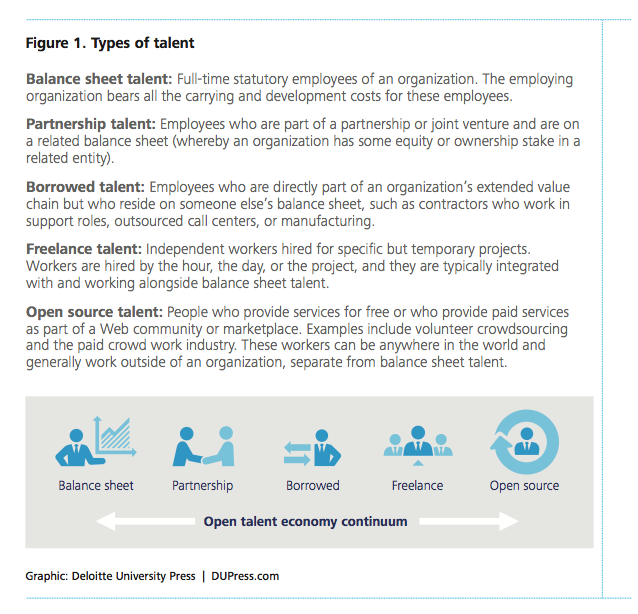
Today’s evolving workforce is a portfolio of full-time employees, contract and freelance talent, and, increasingly, talent with no formal ties to a company at all. People move from role to role and across organizational boundaries more freely than ever. Global markets and products are driven by accelerating innovation and growing scale, and they demand talent pools and systems that can be rapidly assembled and reconfigured. Business leaders and customers expect agility, scale, and the right skills on demand. These new business and talent models look less like integrated factories and companies and more like highly orchestrated networks and ecosystems with a multitude of approaches to mobilizing, orchestrating, and engaging talent, skills, leaders, and ideas.
Chosen excerpts by Job Market Monitor. Read the whole story at




 Job Market Monitor
Discussion
Trackbacks/Pingbacks
Pingback: The Talent War – 63% of CEO said availability of skills was a serious concern (PWC) | Job Market Monitor - July 23, 2014