As the population grows older an increasing percentage of the workforce will be past age 60. Older workers are ordinarily thought to be less productive than younger ones, raising the question of whether an aging workforce will also be a less productive one.
In new research funded by the Social Security Administration, I consider whether an aging workforce has dragged down average worker productivity over the past quarter century. At least so far, the answer is an emphatic “No.” Improved education among the population past 60 and delays in retirement among better educated Americans have tended to boost the earnings of older workers compared with younger ones.
Using one standard benchmark of individual worker productivity—hourly wages—workers between 60 and 74 now earn more than an average worker who is between 25 and 59. The hourly pay premium for older men was about 22 percent in 2011. For older women it was about 10 percent. Other earnings benchmarks show a somewhat less favorable picture, but all of them show considerable improvement in the relative position of aged workers compared with the nonaged over the past two decades. None of the indicators of male productivity suggest that older male workers are less productive than average male workers who are between 25 and 59.
There are two main reasons for the surge in older workers’ earnings. First, the sheer size of the baby boom generation means that the number of Americans attaining age 60 each year is climbing steeply (see Chart 1). Second, labor force participation rates of adults between 60 and 74 have increased. The share of all labor income earned by older workers has soared in recent years because these workers have enjoyed faster wage gains than workers who are younger. It is crucial to understand why this is the case. A major reason is that older workers are now better educated compared with prime-age workers than was the case in the past. Twenty-five years ago the gap in education between prime-age workers and older Americans was large. Americans past 60 had much less schooling than workers who were younger. That gap is now much narrower…

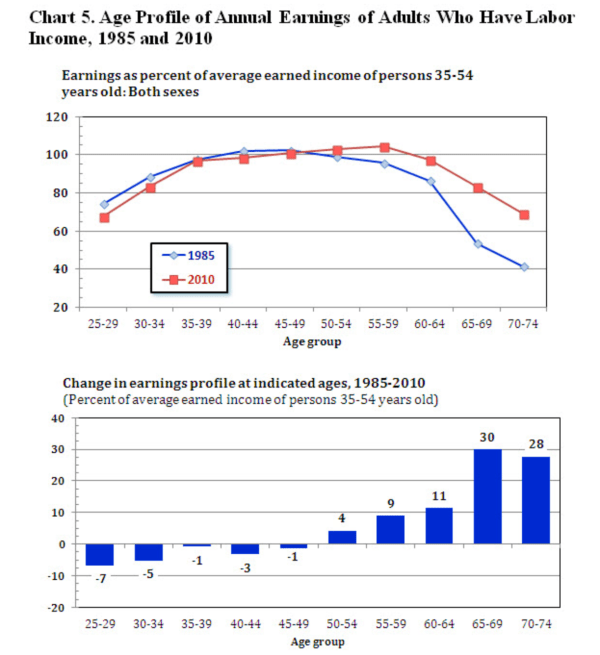
Changes in the distribution of educational attainment have influenced the age profile of earnings. Older workers now receive much better compensation compared with their prime-age counterparts (see Chart 5). Workers younger than 50 have seen a modest decline in their relative annual earnings, but workers past 55 have enjoyed impressive relative earnings gains. Compared with the earnings of an average 35-54 year-old worker, the average worker between 65 and 69 has seen his or her earnings climb 30 percentage points. Workers between 70 and 74 experienced a 28-percentage-point gain in their relative earnings. As noted, the relative earnings gains of older workers can be traced to the improvement in their educational attainment compared with younger workers. However, this development does not fully explain their gains. When I separately tabulate the age-earnings profiles of workers within each educational group I find similar, though generally far smaller, income gains among workers in the oldest age categories.
Chosen excerpts by Job Market Monitor

via Is an Aging Workforce Less Productive? | Brookings Institution.



 Job Market Monitor
Discussion
Trackbacks/Pingbacks
Pingback: The Ageing Workforce in Europe – A report from The Economist Intelligence Unit | Job Market Monitor - March 12, 2014
Pingback: Australia – To raise the nation’s retirement age to 70 | Job Market Monitor - June 25, 2014
Pingback: Increase in Life Expectancy – The greatest cultural and scientific advances in our history or a crisis ? | Job Market Monitor - June 26, 2014
Pingback: US – The end of the “age pyramid” | Job Market Monitor - July 1, 2014
Pingback: Population aging could have effects that are positive study says | Job Market Monitor - November 23, 2014
Pingback: Aging Workforce – What can employers do to mitigate the risks ? | Job Market Monitor - June 26, 2015