In 2012, the unemployment rate of youths aged 15 to 24 was 14.3%, compared with a rate of 6.0% for core-age adults aged 25 to 54. A significant gap between the unemployment rates of youths and adults have been observed every year since 1977. 
Most of the gap between the unemployment rates of youths and adults is the result of higher unemployment inflows among youths. In 2012, 2.6% of youths aged 15 to 24 who were working in a given month became unemployed the next month. In comparison, the corresponding proportion among workers aged 25 to 54 was 1.1%. Inflows to unemployment have been higher among youths than among adults every year since 1977.
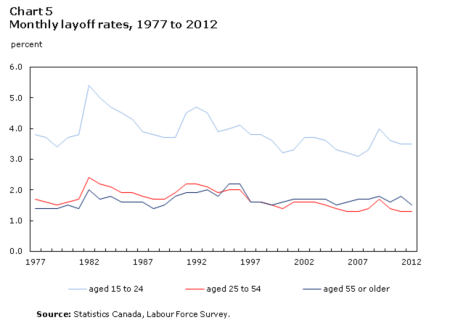 Most workers who become unemployed do so as a result of a layoff. In 2012, the average monthly layoff rate among those aged 15 to 24 was 3.5%, more than double the rate of 1.3% recorded among working adults aged 25 to 54. Part of this difference can be attributed to the lower seniority of younger workers on average. Among a sample of workers of all ages with less than one year of seniority with an employer, the gap between the layoff rates of youths and adults was smaller.
Although younger workers are more likely to become unemployed than adults, unemployment spells among youths are, on average, shorter than among adults. In 2012, 79.4% of youths aged 15 to 24 who had become unemployed were no longer unemployed less than three months later. In comparison, that proportion was 67.6% for adults aged 25 to 54.
Outflow rates within three months of new unemployment spells have been higher among youths than among adults every year since 1982. The gap can be explained in part because younger unemployed were more likely to find work in a shorter period of time than core-age adults. Younger people were also more likely to leave the labour force, most often to attend full-time education.
Even when outflows from unemployment that result in leaving the labour force are excluded, outflow rates within three months of new unemployment spells are higher among youths than among adults. In 2012, 67.6% of youths aged 15 to 24 who had become unemployed and who did not subsequently leave the labour force found a job in less than three months. For adults aged 25 to 54, this proportion was 58.0%.
Chosen excerpts by Job Market Monitor

via Study: Unemployment dynamics among Canada’s youth, 1977 to 2012.



 Job Market Monitor
Discussion
Trackbacks/Pingbacks
Pingback: Canada / Gap between youth and adult employment widest in 35 years | Job Market Monitor - June 12, 2013
Pingback: Canada / From 1981 to 2012, the Changing labour market conditions for youth | Job Market Monitor - July 4, 2013
Pingback: Canada / High youth unemployment does not represent an alarming event says the Certified General Accountants Association of Canada | Job Market Monitor - August 14, 2013
Pingback: Young and Jobless in Ontario / A report by Canadian Centre for Policy Alternatives | Job Market Monitor - September 27, 2013
Pingback: Canada / Youth gather to talk unemployment | Job Market Monitor - October 4, 2013
Pingback: Labor Shortages in Canada / A reason why you’re often behind schedule and over budget | Job Market Monitor - December 9, 2013
Pingback: Canada – 272,300 long-term unemployed last year: a problem for several reasons | Job Market Monitor - May 5, 2014