“With their relentless pursuit of prestige and revenue, the nation’s public and private four-year colleges and universities are in danger of shutting down what has long been a pathway to the middle class for low-income and working-class students” writes Stephen Burd in Undermining Pell – How Colleges Compete for Wealthy Students and Leave the Low-Income Behind on http://newamerica.net.(Adapted chosen excerpts by Job Market Monitor to follow)
The country’s four-year colleges and universities are backing away from the commitment they forged with the federal government nearly 50 years ago to remove the financial barriers that prevent low-income and working-class students from enrolling in and completing college.
This retrenchment is nearly complete in the private non- profit college sector, where only a few dozen schools enroll a substantial share of low-income students and charge them low net prices. While the news is better in the public college sector, the situation is deteriorating fast — as state disinvestment and institutional status-seeking are working together, hand-in-hand, to encourage schools to adopt the enrollment practices of their private college counterparts.
Remarkably, the profound change in the way that colleges are spending their institutional aid dollars has received scant attention in Washington. Federal officials, for the most part, appear to be operating under the assumption that colleges are continuing to complement the govern- ment’s efforts to make higher education more accessible and affordable for the neediest students.
This report presents a new analysis of little-examined U.S. Department of Education data showing the “net price” — the amount students pay after all grant aid has been exhausted — for low-income students at thousands of individual colleges. The anal- ysis shows that hundreds of colleges expect the neediest students to pay an amount that is equal to or even more than their families’ yearly earnings. As a result, these students are left with little choice but to take on heavy debt loads or engage in activi- ties that lessen their likelihood of earning their degrees, such as working full-time while enrolled or dropping out until they can afford to return.
-*-
Colleges provide undergraduates more than $30 billion in institutional grant aid — money from schools’ own bud- gets, beyond state and federal grants — each year. In the past, it would have been fair to assume that most of these funds were being used to make college more accessible and affordable for those with the greatest financial need. But times have changed.
Over the past several decades, a highly influential enroll- ment management industry has emerged to show colleges and universities how they can use their institutional aid dollars strategically in order to increase both their prestige and revenue. Financial aid has increasingly become a weapon that four-year colleges wield as they fiercely com- pete for the students they most desire.
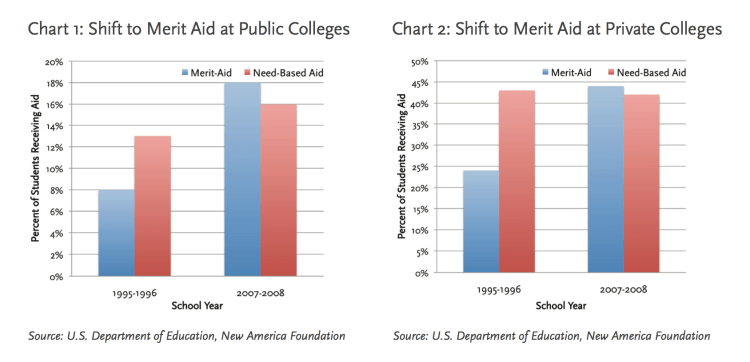
A 2011 report from the U.S. Department of Education’s National Center for Education Statistics (NCES) shows just how dramatic the shift has been.Th e report found that in the 1995-96 school year, both public and private four-year colleges and universities predominantly used their institutional aid resources to try to meet the financial need of their students:
• At public colleges, 8 percent of first-time, full- time students received merit aid, while 13 percent received need-based aid.
• At private colleges, 24 percent received merit aid, while 43 percent received need-based aid.
But by 2007-08, merit aid trumped need-based aid at both types of institutions:
• At public colleges, 18 percent received merit aid, while 16 percent received need-based aid.
• At private colleges, 44 percent received merit aid, while 42 percent received need-based aid.
Although the report doesn’t explore the implications of this change, it’s clear that many of these schools are leveraging their financial aid budgets to buy students who could already afford to attend without the help. In many cases, these institutions are trying to lure in top students who will help them improve their standing in the U.S. News & World Report college rankings so they can enhance their reputations and marketability.
The paper examined 480 public four-year colleges, includ- ing all of the public flagship universities and many state regional colleges, and found the following:
• 164 public colleges, or 34 percent, charge the low- est-income students a net price over $10,000; and 22, or 5 percent, require these students to come up with $15,000 or more.
• These high net price colleges are especially con- centrated in states that have adopted a high- tuition model. For example, 47 of these schools, or more than a quarter of the institutions, are located in two states — Ohio and Pennsylvania — that have long followed a high-tuition, high-aid model. Nearly half the schools come from eight states — Connecticut, Illinois, New Jersey, Ohio, Pennsylvania, South Carolina, Vermont, and Virginia — that have taken this approach.

Full Report @



 Job Market Monitor
Discussion
No comments yet.