Demos investigated the Bureau of Labor Statistics data for young adults in 2012 in order to see how the experience of young people today affects their prospects for tomorrow. We found that last year passed with no significant gains for young people, who continue to endure a jobs crisis even as the economy recovers. The latest numbers from 2013 reveal no significant change in the trend. Without policy targeted to the needs of young adults, we risk a generation marked by the insecurities of the Great Recession for the rest of their working lives.
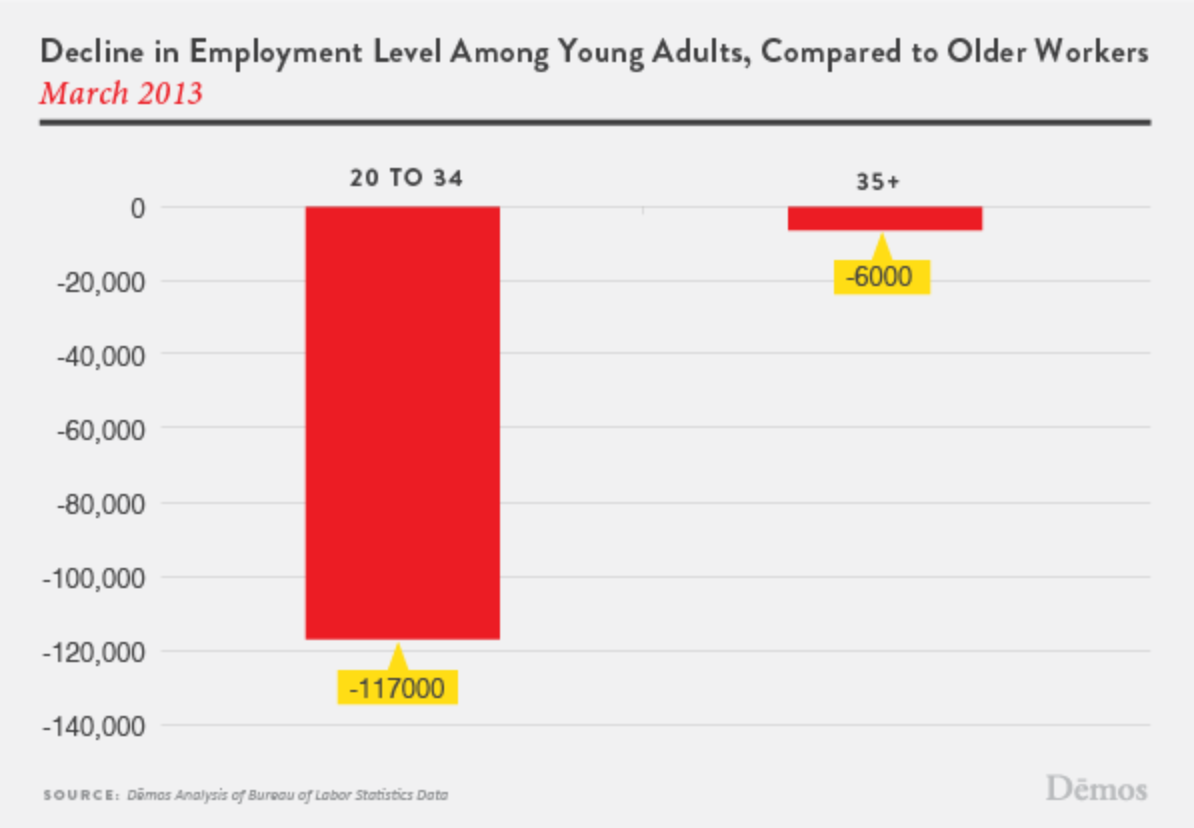
By now, young people are well-aware of their prospects: when the labor force shrank by almost half a million workers last month, more than two-thirds of those who left were under age 35. Maybe they knew what was coming, since employment for 20 to 34-year-olds fell by 117,000 jobs in March—greater losses than among all workers over age 35 combined.
Key Findings
Young people are facing a jobs deficit of over 4 million jobs.
The economy needs to add 4.1 million new jobs for young adults in order to return to employment at the same levels as before the recession began. If we continue to add jobs at the current rate it will be 2022 before the country recovers to full employment. Even then, workers under 25 will face unemployment rates double the national average.
Young adults gained little ground in 2012.
Altogether, there are more than 5.6 million 18 to 34-year-olds who are willing and able to take a job and actively looking for work, but shut out of opportunities for employment. These young adults compose 45 percent of all unemployed Americans. An additional 4.7 million young people were underemployed—either working part time when they really wanted full-time positions or marginalized from the labor market altogether. Last year, the unemployment and underemployment rates for people under 25 were more than double those for workers over 35.
Young African American and Hispanic workers face higher unemployment and underemployment than white workers in their age groups.
Young adult Hispanic workers experience unemployment rates 25 percent higher than those of whites, while African Americans face rates approximately double. One in four African Americans between ages 18 and 24 is looking for a job but cannot find one, as are more than one in seven Hispanic young adults.
The greatest employment differences in any age group appear by education, showing those with no college degree are at a significant disadvantage in the job market.
The unemployment rate for workers with a high school diploma is twice as high as unemployment among workers with a Bachelor’s degree. In the 18 to 24-year-old age group, 19.7 percent of high school graduates with no college experience were unemployed and 1 in 3 was underemployed. Among 25 to 34-year-olds 11.2 percent of those with only a high school degree were unemployed and 1 in 5 were underemployed.
There was not enough job growth in 2012 to pull young people back into the workforce.
In 2012, the labor force participation rate of 18 to 24-year-olds declined to its lowest point in more than four decades. At the same time, 25 to 34-year-olds stopped leaving the job market for the first time since the recession began, but the gains were small. Workers with a four-year degree are 9 to 12 percentage points more likely to be in the labor market than workers with a high school diploma in every age group.
Declining labor force participation rates have stripped the productive capacity of the U.S. workforce.
If young people participated in the labor force today at the same rates they did in 2007, there would be 2.18 million additional 18 to 34-year-olds in the workforce.
Policy has the potential to redress the failures of markets and protect our collective future.
Public investment to directly employ young adults—especially young adults of color and those without a college degree—could address the jobs crisis facing this generation, contribute to the recovery through increased consumer spending, and accomplish the kind of strong, stable, and diverse society that we envision for our future.
Chosen excerpts by Job Market Monitor

via Stuck: Young America’s Persistent Jobs Crisis | Demos.
Full Report @



 Job Market Monitor
Discussion
Trackbacks/Pingbacks
Pingback: US – The underemployment of college graduates is displacing lower skilled workers | Job Market Monitor - March 6, 2014