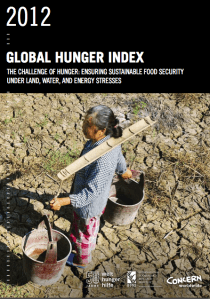
World hunger, according to the 2012 Global Hunger Index (GHI), has declined somewhat since 1990 but remains “serious.” The global average masks dramatic differences among regions and countries. Regionally, the highest GHI scores are in South Asia and Sub-Saharan Africa. South Asia reduced its GHI score significantly between 1990 and 1996—mainly by reducing the share of underweight children—but could not maintain this rapid progress. Though Sub-Saharan Africa made less progress than South Asia in the 1990s, it has caught up since the turn of the millennium, with its 2012 GHI score falling below that of South Asia.
From the 1990 GHI to the 2012 GHI, 15 countries reduced their scores by 50 percent or more. In terms of absolute progress, between the 1990 GHI and the 2012 GHI, Angola, Bangladesh, Ethiopia, Malawi, Nicaragua, Niger, and Vietnam saw the largest improvements in their scores.

Twenty countries still have levels of hunger that are “extremely alarming” or “alarming.” Most of the countries with alarming GHI scores are in Sub-Saharan Africa and South Asia (the 2012 GHI does not, however, reflect the recent crisis in the Horn of Africa, which intensified in 2011, or the uncertain food situation in the Sahel). Two of the three countries with extremely alarming 2012 GHI scores—Burundi and Eritrea—are in Sub-Saharan Africa; the third country with an extremely alarming score is Haiti. Its GHI score fell by about one quarter from 1990 to 2001, but most of this improvement was reversed in subsequent years. The devastating January 2010 earthquake, although not yet fully captured by the 2012 GHI because of insufficient availability of recent data, pushed Haiti back into the category of “extremely alarming.” In contrast to recent years, the Democratic Republic of Congo is not listed as “extremely alarming,” because insufficient data are available to calculate the country’s GHI score. Current and reliable data are urgently needed to appraise the situation in the country.
In the coming decades food security will be increasingly challenged by land, water, and energy scarcity. To improve poor people’s nutrition and food security in this environment, we will need to make a diverse range of foods more available and accessible, identify and address wasteful practices and policies, and ensure that local communities have greater control over and access to productive resources. In other words, we need to build a sustainable world, where the degradation of ecosystems is halted or reversed and all people have access to food, clean water, and modern energy and are empowered to use them for their own well-being.
Chosen excerpts by Job Market Monitor
via 2012 Global Hunger Index | International Food Policy Research Institute (IFPRI).
Full Report @



 Job Market Monitor
Discussion
No comments yet.