Fiscal stimulus, in the form of large discretionary increases in federal spending and tax reductions, is often triggered by a strong and persistent rise in the national unemployment rate. The most recent example was the $860 billion (6 percent of GDP) stimulus contained in the 2009 American Recovery and Reinvestment Act (ARRA), adopted in the context of rising unemployment rates. The spending components of the program were varied, including federal transfers to state governments to support education and social services, assistance to unemployed and disadvantaged individuals, and funds for capital construction projects. The majority of the stimulus funds were allocated to state governments and, since the program was motivated by high and rising aggregate unemployment, a reasonable expectation would have been that states with high unemployment rates would receive large allocations. Our analysis of the distribution of ARRA funds across states shows that the expanded assistance to unemployed workers was indeed highly correlated with state unemployment rates. It turned out, however, that most other state allocations had little association—positive or negative—with state unemployment rates. The ultimate distribution instead seemed to reflect a number of practical considerations involved in implementing such a vast spending program. In this post, we outline what in our view were the key considerations that governed the distribution of the stimulus spending across states, and we use the example of one component of that spending—highway infrastructure investment—to illustrate how the stimulus funds got to the states.
Using per capita stimulus dollars in a state as the spending metric, the scatter plot below shows the lack of correlation between stimulus spending and state unemployment rates at the time the program was introduced. The lack of correlation is also evident in a comparison of spending with the cyclical change in state unemployment rates at the time.

The allocation of ARRA aid was determined as follows: The program set aside $1 billion for aid to Native American reservations and federal lands, on-the-job-training programs, Puerto Rico and other U.S. territories, and administrative expenses. Of the remaining funds, roughly 50 percent was distributed to states based on the formula used to distribute highway aid in 2008, and 50 percent was distributed based on each state’s share of total lane miles (25 percent), total vehicles miles traveled (40 percent) on federal-aid highways, and each state’s share of the taxes paid by highway users (35 percent). There were also some funds set aside for sub-state areas with a population of less than 200,000. The graph below shows that this allocation formula led to highway spending across states that did not have a positive relationship with unemployment rates.
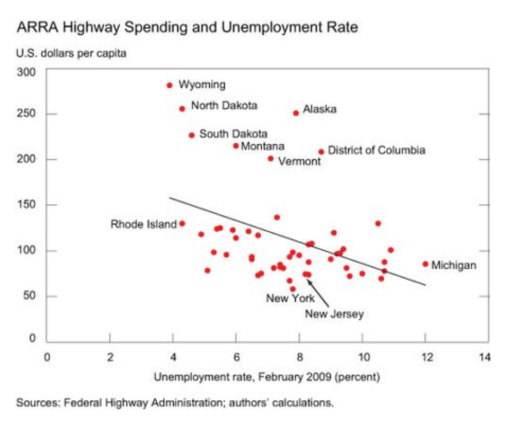
In sum, practical considerations in targeting new federal spending under a vast program like the ARRA led to spending that was less linked to state unemployment rates than might be expected. Estimates vary as to the effects of the ARRA, but larger questions remain. Did the particular way that the funds were targeted affect the ultimate impact of the program? Would a given amount of funding distributed in another way have been more effective? Would future anti-recessionary spending programs benefit from pre-planned allocation formulas? Answering those questions would take more than a blog post.
Chosen excerpts by Job Market Monitor

via State Unemployment and the Allocation of Federal Stimulus Spending – Liberty Street Economics.



 Job Market Monitor
Discussion
No comments yet.