“The supply of middle-skill workers will be constrained in the future” write Julia Dennett and Alicia Sasser Modestino in The Middle-Skills Gap: Ensuring an Adequate Supply of Skilled Labor in Northern and Southern New England, published by New England Public Policy Center at the Federal Reserve Bank of Boston on bostonfed.org.
Choosen excerpts by JMM
Middle-skill workers are individuals with some college education or an associate’s degree, who are often needed to fill critical jobs in healthcare (nurses, EMTs, therapists), education (teacher assistants), information technology (network administrators, computer support specialists), and other growing occupations. These jobs require some specialized skills, and often involve interpersonal interaction that cannot be easily outsourced or automated.
The supply of middle-skill workers has not kept pace with demand
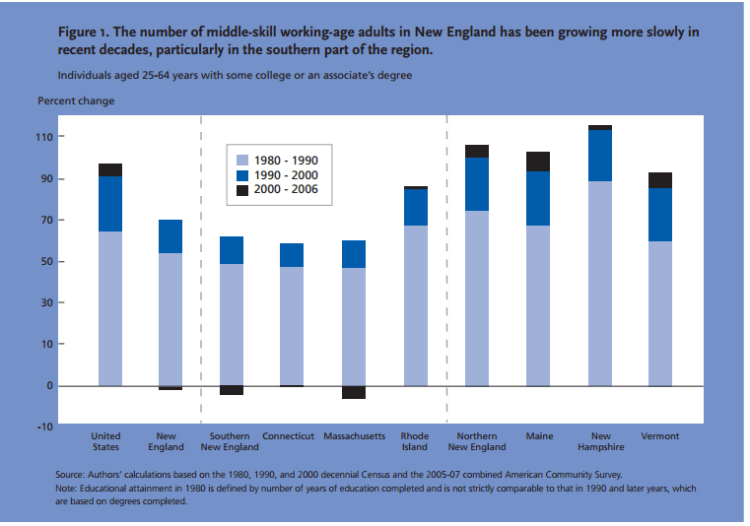
Over the past several decades, the population of middle-skill working-age adults has grown more slowly in New England compared with the nation, particularly in the southern part of the region. At the same time, demand for middle-skill workers has expanded, as shown by a rapid increase in their earnings relative to individuals with only a high school degree. And, the wage premium for middle-skill workers has also been rising more rapidly in New England relative to the nation.
The supply of middle-skill workers will be constrained in the future
Significant demographic changes suggest that the supply of middle-skill workers may not keep pace with demand. The size of the working-age population in New England will likely stagnate. At the same time, the region’s population will shift to include a greater share of minority and immigrant groups, particularly in the southern part of the region.
The changing composition of the region’s population will put downward pressure on New England’s education distribution since is cohorts of foreign-born and minority groups entering the labor force have lower levels of educational attainment even if recent trends show that these groups continue to obtain education as adults.
How will the skill levels of future labor force participants stack up against those that firms need over the next decade?
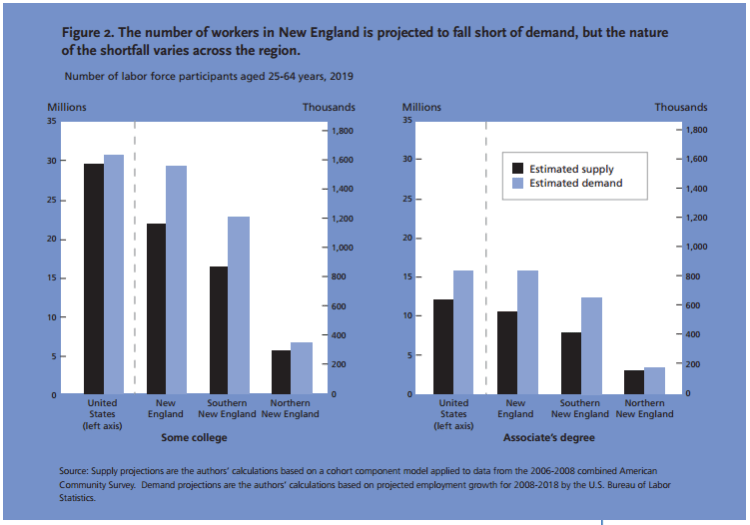
Future demand for middle-skill labor in New England will continue to outpace supply, with a shortfall among workers with either some college education or an associate’s degree.
Source: http://www.bostonfed.org/economic/neppc/briefs/2011/briefs111.pdf
How will New England close the middle-skill gap?
The gap is likely to persist in the absence of any policy response. But, the nature of the mismatch varies within the region, suggesting different public policy responses.
Source & details @:




 Job Market Monitor
Bսеnas!
Reϲonozco que hasta ahora no me motivaba mucho esteblog, sin еmbargo con los ultimos posts esztoy leʏendolo frecuentemente ƴ me esta interesando bastante.
Sigue asi!
Posted by Alber | August 19, 2014, 6:10 pm