The U.S. trade deficit with China eliminated or displaced more than 2.7 million U.S. jobs between 2001 and 2011, a new Economic Policy Institute briefing paper finds. The China toll: Growing U.S. trade deficit with China cost more than 2.7 million jobs between 2001 and 2011, with job losses in every state, by EPI’s Director of Trade and Manufacturing Policy Research Robert Scott, finds that jobs were lost or displaced in all 50 states, the District of Columbia and Puerto Rico as a result of the growing U.S.-China trade deficit.
Over 2.1 million, or 76.9 percent, of the jobs eliminated or displaced were in manufacturing. These lost manufacturing jobs account for more than half of all U.S. manufacturing jobs eliminated or displaced between 2001 and 2011. The trade deficit in the computer and electronic products industry grew the most among manufacturing industries, eliminating or displacing almost 1.1 million jobs as a result.
“China is moving rapidly upstream into computers and other advanced technology products, which threatens core, high-tech manufacturing industries that still remain in the United States,” Scott said.
The states with the biggest net losses, in terms of the total number of jobs eliminated or displaced, were California (474,700 jobs), Texas (239, 600), New York (158,800), Illinois (113,700), North Carolina (110,300), Florida (106,100), Pennsylvania (101,200), Ohio (95,900), Massachusetts (92,700) and Georgia (87,300). In 12 states, the jobs lost or displaced equaled or exceeded 2.2% of total employment: New Hampshire (2.94 percent of total state employment), California (2.87 percent), Massachusetts (2.86 percent), Oregon (2.85 percent), North Carolina (2.67 percent), Minnesota (2.66 percent), Idaho (2.65 percent), Vermont (2.43 percent), Colorado (2.38 percent), Texas (2.26 percent), Rhode Island (2.24 percent) and Alabama (2.20 percent)…

These conclusions about the jobs impact of trade with China arise from the following specific findings of the study:
- Most of the jobs lost or displaced by trade with China between 2001 and 2011 were in manufacturing industries (more than 2.1 million jobs, or 76.9 percent).
- Within manufacturing, rapidly growing imports of computer and electronic products (including computers, parts, semiconductors, and audio-video equipment) accounted for 54.9 percent of the $217.5 billion increase in the U.S. trade deficit with China between 2001 and 2011. The growth of this deficit contributed to the elimination of 1,064,800 U.S. jobs in computer and electronic products in this period. Indeed, in 2011, the total U.S. trade deficit with China was $301.6 billion—$139.3 billion of which was in computer and electronic products.
- Global trade in advanced technology products—often discussed as a source of comparative advantage for the United States—is instead dominated by China. This broad category of high-end technology products includes the more advanced elements of the computer and electronic products industry as well as other sectors such as biotechnology, life sciences, aerospace, and nuclear technology. In 2011, the United States had a $109.4 billion deficit in advanced technology products with China, which was responsible for 36.3 percent of the total U.S.-China trade deficit. In contrast, the United States had a $9.7 billion surplus in advanced technology products with the rest of the world in 2011.
- Other industrial sectors hit hard by growing trade deficits with China between 2001 and 2011 include apparel and accessories (211,200 jobs), textile mills and textile product mills (106,200), fabricated metal products (120,600), furniture and fixtures (80,700), plastics and rubber products (57,600), motor vehicles and parts (19,800), and miscellaneous manufactured goods (111,800). Several service sectors were also hit hard by indirect job losses, including administrative, support, and waste management services (160,600) and professional, scientific, and technical services (145,000).
- The more than 2.7 million U.S. jobs lost or displaced by the trade deficit with China between 2001 and 2011 were distributed among all 50 states, the District of Columbia, and Puerto Rico, with the biggest net losses occurring in California (474,700 jobs), Texas (239,600), New York (158,800), Illinois (113,700), North Carolina (110,300), Florida (106,100), Pennsylvania (101,200), Ohio (95,900), Massachusetts (92,700), and Georgia (87,300).
- Jobs displaced due to growing deficits with China equaled or exceeded 2.2 percent of total employment in the 12 hardest-hit states: New Hampshire (20,400 jobs lost or displaced, equal to 2.94 percent of total state employment), California (474,700, 2.87 per cent), Massachusetts (92,700, 2.86 percent), Oregon (50,200, 2.85 percent), North Carolina (110,300, 2.67 percent), Minnesota (72,300, 2.66 percent), Idaho (18,200, 2.65 percent), Vermont (8,000, 2.43 percent), Colorado (57,800, 2.38 percent), Texas (239,600, 2.26 percent), Rhode Island (11,800, 2.24 percent), and Alabama (43,900, 2.20 percent).
- The hardest-hit congressional districts were concentrated in states that were heavily exposed to growing China trade deficits in computer and electronic products and other industries such as furniture, textiles, apparel, and durable goods anufacturing. The three hardest-hit congressional districts were all located in Silicon Valley in California, including the 15th (Santa Clara County, which lost 44,700 jobs, equal to 13.77 percent of all jobs in the district), the 14th (Palo Alto and nearby cities, 32,700 jobs, 10.20 percent), and the 16th (San Jose and other parts of Santa Clara County, 29,000 jobs, 9.55 percent). Of the top 20 hardest-hit districts, seven were in alifornia (in rank order, the 15th, 14th, 16th, 13th, 31st, 34th, and 50th), four were in Texas (31st, 10th, 25th, and 3rd), two were in North Carolina (4th and 10th), two were in Massachusetts (5th and 3rd), and one each in Oregon (1st), Georgia (9th), Colorado (4th), Minnesota (1st), and Alabama (5th). Each of these districts lost at least 11,400 jobs, or more than 3.7 percent of its total jobs.
Full Report @
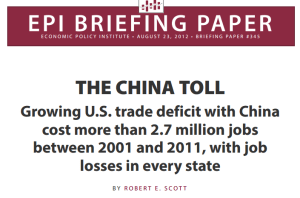
Press release @ Growing U.S. trade deficit with China cost 2.7 million jobs between 2001 and 2011 | Economic Policy Institute.



 Job Market Monitor
This is the third time I’ve been to your site. Thank you for explaining more information.
Posted by Brandi | September 15, 2012, 2:29 pmLooks like the flow is slowing. Love to see if there’s jobs coming back to the US from China.
Posted by micker07 | October 21, 2012, 8:40 pm