The 2007 Expansion of the Work Opportunity Tax Credit (WOTC) Program Increased Employment Among Disabled Veterans concludes Paul Heaton in The Effects of Hiring Tax Credits on Employment of Disabled Veterans published by rand.org. (adapted excerpts by Job Market Monitor to follow)
Among the myriad federal programs available to assist unemployed veterans, few have been subjected to the rigorous empirical evaluation necessary to establish whether they are effective at actually getting veterans hired. This paper provides some of the first quantitative evidence demonstrating that employer tax credits, which have become an increasingly popular tool in the federal effort to assist unemployed veterans, can be successful at improving employment rates among disabled veterans.
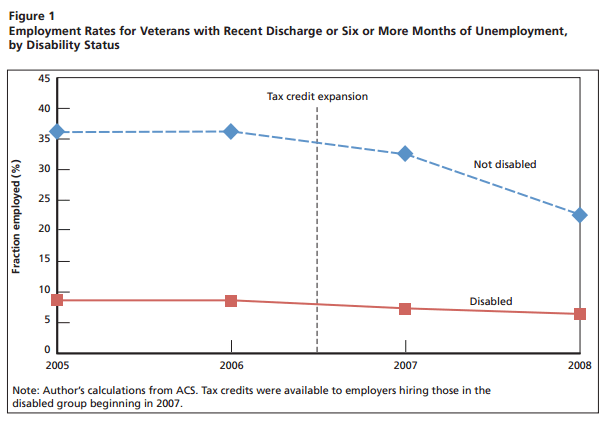
While the employment gap between the disabled and nondisabled was fairly stable between 2005 and 2006, after the policy was initiated, employment fell much less for the disabled group than for the nondisabled group. If the nondisabled are a valid control group, this pattern suggests that, absent the program, employment for the disabled would have fallen more dramatically.
Main Findings
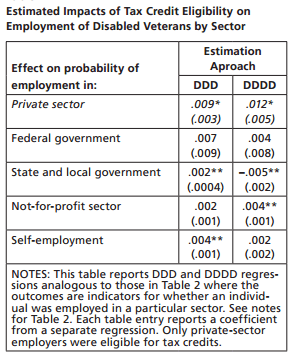
- The WOTC program increased employment among disabled veterans by 2 percentage points in 2007 and 2008, representing roughly 32,000 jobs each year.
- The WOTC program also increased annual the wage income of the target group by 40 percent, which equates to roughly $1,000 per eligible individual.
- Benefits were largest for older veterans and veterans who did not come from disadvantaged backgrounds.
- Both those with cognitive and noncognitive impairments benefited from the tax credits.
- Rough calculations place the cost of the WOTC program per job generated at around $10,000 or less.
Since 2008, there have been additional expansions of the WOTC that provided larger dollar incentives for hiring and broadened coverage to a wider set of veterans. Although a definitive evaluation of these more recent expansions awaits further study, the present analysis suggests that those investments may provide a valuable source of labor market support for returning and injured veterans during a period of continued labor market weakness. At the same time, given that this analysis suggests that the benefits of the tax credits may have accrued primarily to certain segments of the disabled veteran population, such as older veterans, it will be important going forward to consider how hiring incentives, such as those in the WOTC, can be designed to benefit the widest possible set of veterans.
Employer tax credits may provide a valuable source of labor market support for returning and injured veterans and can be an effective means of enhancing employment even among groups, such as the disabled, who have traditionally experienced low rates of labor force participation.
via The Effects of Hiring Tax Credits on Employment of Disabled Veterans | RAND.



 Job Market Monitor
Discussion
Trackbacks/Pingbacks
Pingback: UK | Ageism is back « Global Job Gap, Local Skills Gap - April 15, 2012
Pingback: Georgia | Some of highest income taxes on the working poor « Global Job Gap, Local Skills Gap - April 17, 2012
Pingback: First generation of employers with no widespread military experience makes finding a job hard for veterans – latimes.com « Global Job Gap, Local Skills Gap - April 26, 2012
Pingback: UPDATE – Ageism | Job-hogging over-50s « Global Job Gap, Local Skills Gap - April 27, 2012
Pingback: Employment Services to Veterans with Disabilities in US | Job Market Monitor - April 22, 2014