 The Atlantic Cities: Inequality is shaping up to be one of the biggest issues in the 2012 presidential election. The Occupy movement may have waned since last fall, but its focus on the privileges of the top one percent has yet to go away.
Most economists argue that rising inequality is driven by broader structural changes in the economy. Globalization has shifted manufacturing jobs to lower wage countries like China; new technologies and increases in productivity have eliminated millions of the low-skill but high-paying jobs that were left.
As the middle class has disappeared, the job market has literally cleaved in two. On one side are high-paying, professional, knowledge, and creative jobs that require considerable education and skill. But the number of lower-wage jobs in fields like personal care, retail sales, and food service is expanding even faster. This process, one of “skill-biased technical change,” according to MIT economist David Autor, has shaped the huge rise in wage inequality, which in turn underpins a broader set of social, cultural, geographic, income, and other inequalities.
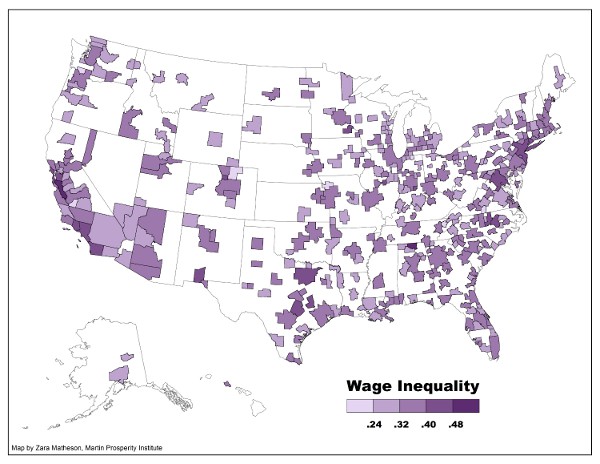
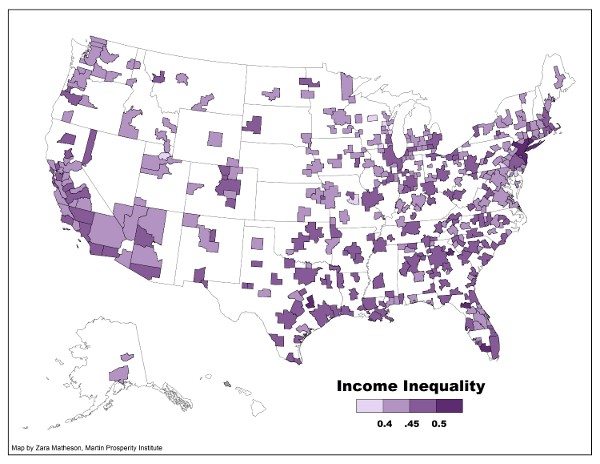
Most studies of inequality have focused exclusively on its manifestations on a national or international scale, but there is much to be learned by examining local patterns. With the help of my Martin Prosperity Institute colleagues Kevin Stolarick, Charlotta Mellander, and Zara Matheson, I began by simply mapping two different measures of inequality – wage inequality and income inequality – across America’s 350 metro areas…
Read More @:

via The Inequality of American Cities – Jobs & Economy – The Atlantic Cities.



 Job Market Monitor
Discussion
Trackbacks/Pingbacks
Pingback: Giving Low-Income Students Money Will Reduce Inequality « The Daily Pot - March 10, 2012
Pingback: Obama | Income Inequality Hurts « Global Job Gap, Local Skills Gap - April 11, 2012
Pingback: It’s the economy, not the taxe code, which generates inequalities « Global Job Gap, Local Skills Gap - April 24, 2012