In the light of the importance of skills for the EU economy and the European Year of Skills, the 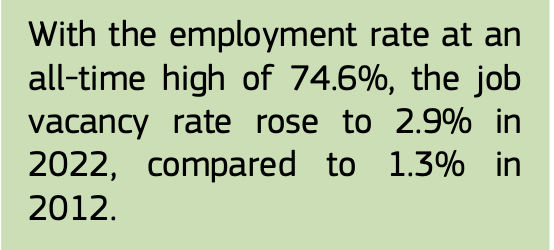 2023 annual Employment and Social Developments in Europe (ESDE) review, entitled “Addressing labour shortages and skills gaps in the EU”, provides evidence on persistent labour shortages and changing skills needs in the EU. The report considers the implications of skills demands in the context of the green and digital transitions. It highlights certain labour market participation challenges, including demographic changes (notably ageing) and lower labour market participation among certain population groups, with a particular focus on women and migrant workers born outside the EU.
The analysis shows that labour shortages are found in a diverse range of occupations across all skill levels: construction, healthcare, science, ICT, engineering and mathematics (STEM). The importance of the structural drivers, underlying shortages, vary by occupation and sector. Overall, the working conditions or human resource management (HRM) practices are more often linked to employers’ difficulties in finding people, rather than a lack of skills among job applicants. Still, a limited supply of skilled workers poses challenges in certain fields (e.g. STEM, healthcare).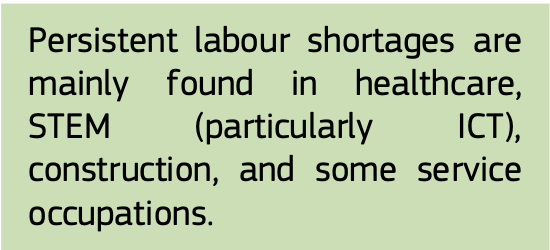
The report highlights the importance of policies and reform measures to alleviate persistent labour shortages. Those include investing in training and adult learning, increasing financial incentives to work, alleviating the barriers to people entering the labour market, improving work and pay conditions and social protection coverage, and implementing policies to attract workers from abroad into jobs facing shortages.
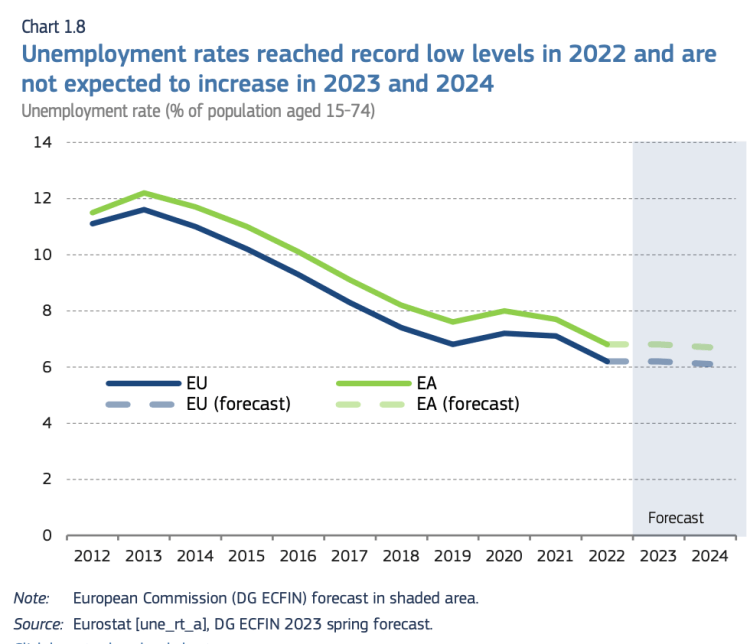
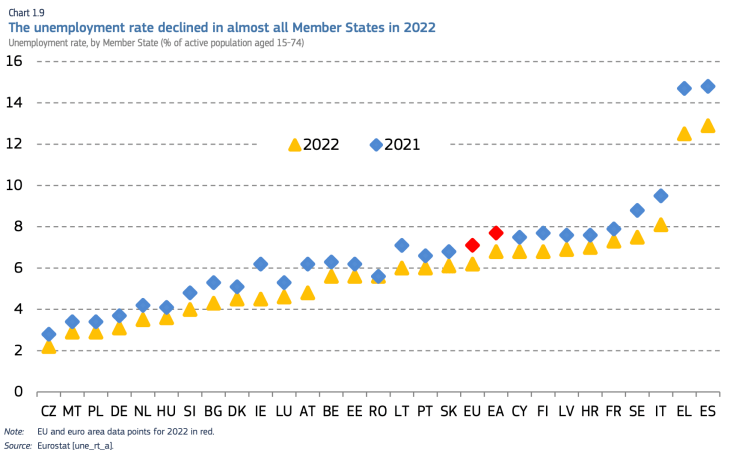
The report reveals that despite the impact of Russia’s invasion of Ukraine resulting in an economic slowdown in the second half of 2022, EU labour markets have demonstrated remarkable resilience in 2022. The EU economy grew by 3.5% in real terms in 2022. 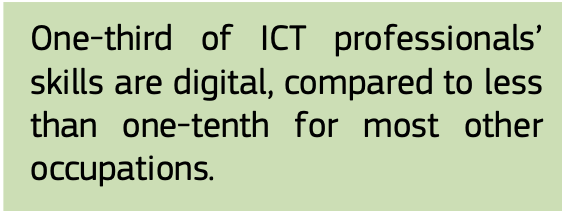 Employment rates were at a record high at 74.6% with 213.7 million people employed in 2022, and unemployment rates at a historic low at 6.2%.
However, challenges remain with a low labour market representation of certain groups, such as women or persons with a disability. Youth unemployment fell from 16.7% in 2021 to 14.5% in 2022, but remains a major challenge. In addition, companies face labour shortages and there is the need for both employers and workers to adapt to evolving skill needs, in the context of the green and digital transitions.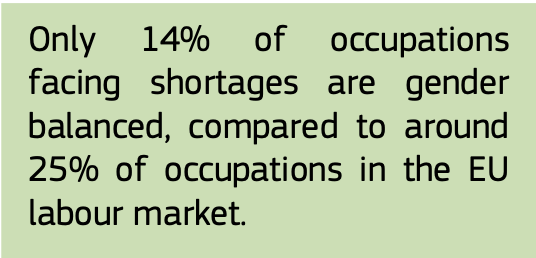
The share of people at risk of poverty or social exclusion remained stable at 21.6% in 2022 with social transfers reducing poverty by more than one third on average in the EU. However, real household income declined, as high inflation continued to erode purchasing power. This resulted in a rise in severe material and social deprivation (from 6.3% to 6.7%).
Main finding
The report reveals that despite the impact of Russia’s invasion of Ukraine resulting in an economic slowdown in the second half of 2022, EU labour markets have demonstrated remarkable resilience in 2022. The EU economy grew by 3.5% in real terms in 2022. 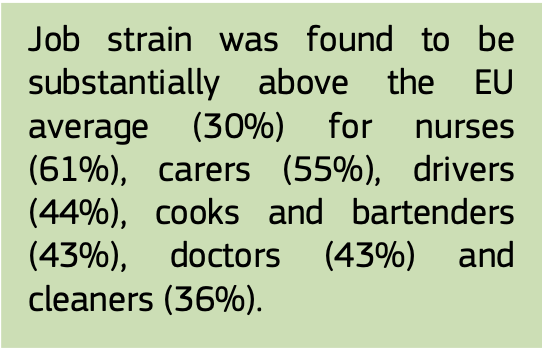 Employment rates were at a record high at 74.6% with 213.7 million people employed in 2022, and unemployment rates at a historic low at 6.2%.
However, challenges remain with a low labour market representation of certain groups, such as women or persons with a disability. Youth unemployment fell from 16.7% in 2021 to 14.5% in 2022, but remains a major challenge. In addition, companies face labour shortages and there is the need for both employers and workers to adapt to evolving skill needs, in the context of the green and digital transitions.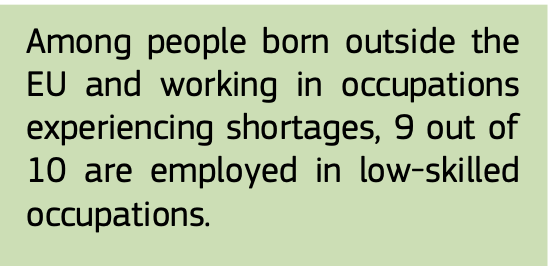
The share of people at risk of poverty or social exclusion remained stable at 21.6% in 2022 with social transfers reducing poverty by more than one third on average in the EU. However, real household income declined, as high inflation continued to erode purchasing power. This resulted in a rise in severe material and social deprivation (from 6.3% to 6.7%).
Main findings
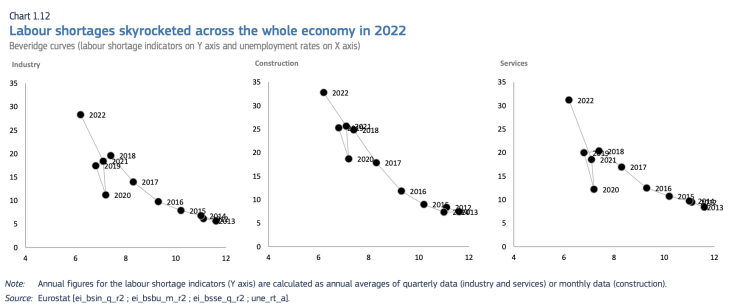
- Persistent labour shortages are found in a diverse range of occupations across all skill levels. They are particularly prevalent in construction, healthcare, science, technology(notably ICT), engineering and mathematics (STEM.) Looking ahead, shortages in both high-skilled and low-skilled occupations are expected to continue as the population ages and the green and digital transitions advance.
- While the digital transition contributes to persistent labour shortages in the ICT sector, it does not seem to be a key driver of shortages in other occupations. Indeed, one third of the skills required for an ICT professional are digital skills, while for most other occupations digital skills represent less than a tenth of all skills needed.
- The aging population is a major trend affecting labour shortages, considering that, while fewer people will be working, consumption by an increasing older population will remain sustained. While the working age population (20-64-year-olds) had reached a record of 272 million people in 2009, it declined to 265 million by 2022, and it is expected to reach 258 million by 2030.
- The lower labour market participation of women, lower-educated people, people with a migrant background, as well as of older and young people also contributes to labour shortages.
- Structural drivers contributing to persistent labour shortages vary by occupation and sector:
- Jobs shortages are often linked to insufficient supply of workers with highly specialist skills, for example in the STEM occupations, including ICT. In the context of the green transition, the investment needs for retraining, reskilling and upskilling in manufacturing of strategic net-zero technologies are estimated between 1.7 billion EUR and 4.1 billion EUR up to 2030.
- At the same time, employers’ difficulties in finding people with the right skills are often linked to their inability to attract and retain workers (e.g. due to poor working conditions or human resource management). For example, the so-called “job strain”, which refers to difficult work environment, organisation and time, is substantially above the EU average for nurses, carers, drivers, cooks and bartenders, doctors and cleaners.
- Most shortage occupations are either dominated by men or by women – 86% of these occupations are not gender-balanced. This also mirrors gender segregation in the respective field of studies, which is why the pool of people to fill vacancies is limited.
- Workers born outside the EU are more often employed in occupations facing persistent labour shortages, in particular in low-skilled occupations. They are 8.7 pp more likely to work in occupations with persistent labour shortages compared to workers born inside the EU.
- Solutions – several policy and reform measures can alleviate labour shortages:
- Reforming tax and benefit systems can improve work incentives, which can help alleviate labour shortages. In general, tax reforms targeting low-income earners have a significantly greater impact on people’s labour supply than across-the-board personal income tax cuts.
- Investing in adult learning and skills development and training programmes, as well as better job matching with people’s education, experience, and skills.
- Improving working conditions in certain jobs to attract additional workers, including by involving social partners.
- Making available accessible, affordable, and high-quality early childhood education and care can contribute to addressing labour shortages by removing barriers to entering the labour market. Overall, increasing childcare participation among children aged 0-2 living in households below median income to the Barcelona target of 45% would increase the participation of mothers by 5 pp in Italy, 10 pp in Hungary, and 17 pp in Austria.
- Promoting targeted labour migration from non-EU countries to reduce labour shortages in specific skills groups.
- Enhancing social dialogue and involving social partners in training, improving working conditions, and facilitating adult learning opportunities.
Chosen excerpts by Job Market Monitor. Read the whole story @ Publications catalogue – Employment, Social Affairs & Inclusion – European Commission



 Job Market Monitor
Discussion
No comments yet.