Even as job markets are tight in many major economies, low unemployment is failing to spur robust increases in wages, leaving workers angry.
In many major countries, including the United States, Britain and Japan, labor markets are exceedingly tight, with jobless rates a fraction of what they were during the crisis of recent years. Yet workers are still waiting for a benefit that traditionally accompanies lower unemployment: fatter paychecks.
Some economists argue that the world is still grappling with the hangover from the worst downturn since the Great Depression. Once growth gains momentum, employers will be forced to pay more to fill jobs.
But other economists assert that the weak growth in wages is an indicator of a new economic order in which working people are at the mercy of their employers. Unions have lost clout. Companies are relying on temporary and part-time workers while deploying robots and other forms of automation in ways that allow them to produce more without paying extra to human beings. Globalization has intensified competitive pressures, connecting factories in Asia and Latin America to customers in Europe and North America.
“Generally, people have very little leverage to get a good deal from their bosses, individually and collectively,” says Lawrence Mishel, president of the Economic Policy Institute, a labor-oriented research organization in Washington. “People who have a decent job are happy just to hold on to what they have.”
The reasons for the stagnation gripping wages vary from country to country, but the trend is broad.
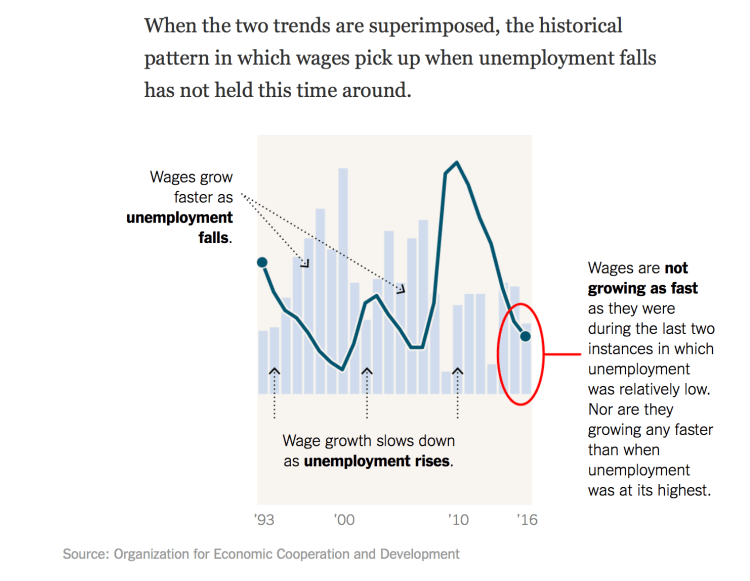
Why wages are not rising faster amounts to a central economic puzzle.
In 1972, so-called production and nonsupervisory workers — some 80 percent of the American work force — brought home average wages equivalent to $738.86 a week in today’s dollars, after adjusting for inflation, according to an Economic Policy Institute analysis of federal data. Last year, the average worker brought home $723.67 a week.
Chosen excerpts by Job Market Monitor. Read the whole story at Global Economy’s Stubborn Reality: Plenty of Work, Not Enough Pay – The New York Times



 Job Market Monitor
Discussion
Trackbacks/Pingbacks
Pingback: Wage Growth Slowdown in Australia – The extent and causes | Job Market Monitor - April 15, 2019
Pingback: Wages – Decline in organized labor has reduced the bargaining power of labor across the developed world Bridgewater says | Job Market Monitor - April 18, 2019