Efforts to fully realize people’s economic potential – in countries at all stages of economic development – are falling short due to ineffective deployment of skills throughout the workforce, development of future skills and adequate promotion of ongoing learning for those already in employment. These failures to translate investment in education during the formative years into opportunities for higher-quality work during the working lifetime contributes to income inequality by blocking the two pathways to social inclusion, education and work, according to the World Economic Forum’s Human Capital Report 2017, which is published today.
The report measures 130 countries against four key areas of human capital development; Capacity, largely determined by past investment in formal education; Deployment, the application and accumulation of skills through work; Development, the formal education of the next generation workforce and continued upskilling and reskilling of existing workers; and Know-how, the breadth and depth of specialized skills-use at work. Countries’ performance is also measured across five distinct age groups or generations: 0-14 years; 15-24 years; 25-54 years; 55-64 years; and 65 years and over.
According to the report’s Human Capital Index, 62% of human capital has now been developed globally. Only 25 nations have tapped 70% of their people’s human capital or more. With the majority of countries leveraging between 50% and 70% of their human capital, 14 countries remain below 50%.
A fundamental tenet of the report is that accumulation of skills does not end at a formal education, and the continuous application and accumulation of skills through work is part of human capital development. All too often economies already possess the required talent but fail to deploy it.
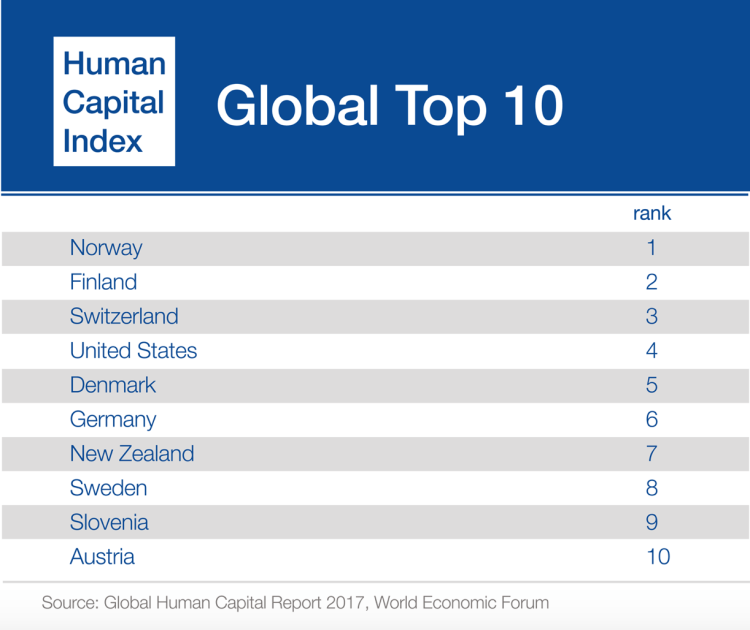
Chosen excerpts by Job Market Monitor. Read the whole story at Global Human Capital Report 2017 – Reports – World Economic Forum



 Job Market Monitor
Discussion
No comments yet.