The unemployment rate declined to 4.6 percent in November, and total nonfarm payroll
employment increased by 178,000, the U.S. Bureau of Labor Statistics reported today.
Employment gains occurred in professional and business services and in health care.
Household Survey Data
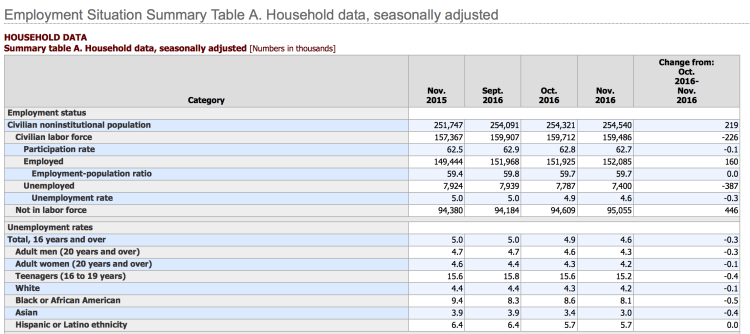
In November, the unemployment rate decreased by 0.3 percentage point to 4.6 percent,
and the number of unemployed persons declined by 387,000 to 7.4 million. Both measures had shown little movement, on net, from August 2015 through October 2016. (See table A-1.)

Chosen excerpts by Job Market Monitor. Read the whole story at Employment Situation Summary
In the book of United States economic history, the November jobs numbers released on Friday would make a fitting end to a particularly long, terrifying chapter that began nine years ago.
The unemployment rate fell to 4.6 percent, the Labor Department said, from 4.9 percent. The last time it was this low was August 2007. That was the month, you may recall, when global money markets first froze up because of losses on United States mortgage-related bonds: early tremors of what would become a recession four months later and a global financial crisis nine months after that.
In the last nine years, we’ve witnessed events in economic, financial and political history so convulsive that our 2007 selves wouldn’t have been able to imagine them. But while the political future may be more uncertain than ever, the economic and financial outlook is getting mercifully boring again.

Chosen excerpts by Job Market Monitor. Read the whole story at The New Jobs Numbers Signal the End of an Economic Era – The New York Times



 Job Market Monitor
Discussion
No comments yet.