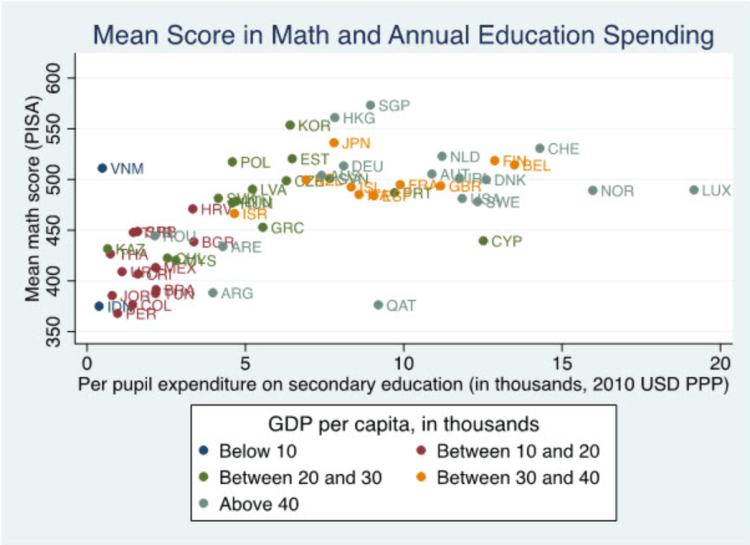
A simple correlation analysis using cross-country data suggests that there is at best a weak relationship between student achievement and education spending. In other words, when comparing per pupil spending and average learning outcomes per country, we find that countries with similar levels of spending per student also show enormous differences in how much their students learn. Figure 1 shows the simple correlation between mean scores in math in the Organization for Economic Co-operation and Development’s (OECD) Program for International Student Assessment, or PISA, and per pupil spending in secondary education for each of the countries that participated in PISA 2012. It is easy to see that students in countries like Qatar and Singapore, which spend similar amounts of dollars per student, achieve vastly different PISA math scores.
Figure 1: Per pupil spending and mean math scores in PISA 2012, by country
Source: Vegas and Coffin, 2015.
Working in developing countries throughout my career, I was always struck by the weak relationship between spending and outcomes. While, it was clear that differences in student learning between countries with similar spending levels, such as Qatar and Singapore, support the leading argument that how money is spent in education is more important than how much, I wondered whether this was only the case for countries that spend above a minimum level—a level that guarantees a minimum standard of basic inputs to ensure adequate learning opportunities for all.
Could in fact countries that spend little on education achieve good learning outcomes by simply spending more efficiently?
With my colleague Chelsea Coffin, I set out to explore the relationship between per pupil spending and learning, particularly in developing countries that spend much lower levels in education than do OECD countries. To do this, we separated countries that have participated in PISA into two groups based on their level of per pupil expenditure: a low-spending group, comprised of countries that spend less than a certain threshold per student; and a high-spending group, which included the countries that spend more than that threshold. Then, we designed separate regressions to estimate the relationship between spending and student learning (as measured by PISA) within these two groups of countries. We wanted to see if, among the low-spending group, more spending is associated with higher outcomes. Additionally, we wanted to estimate the per pupil spending level at which more money no longer can be associated with higher learning outcomes.
Put simply, our underlying hypothesis was that if Haiti only spends $100 per student, common sense suggests that it cannot reach the average learning levels of OECD countries that spend much more per student. However, does the country need to increase spending to the U.S. level ($11,732) or Finland’s level ($9,353) in order for their students to be able to learn the basic skills necessary compete in today’s global economy?
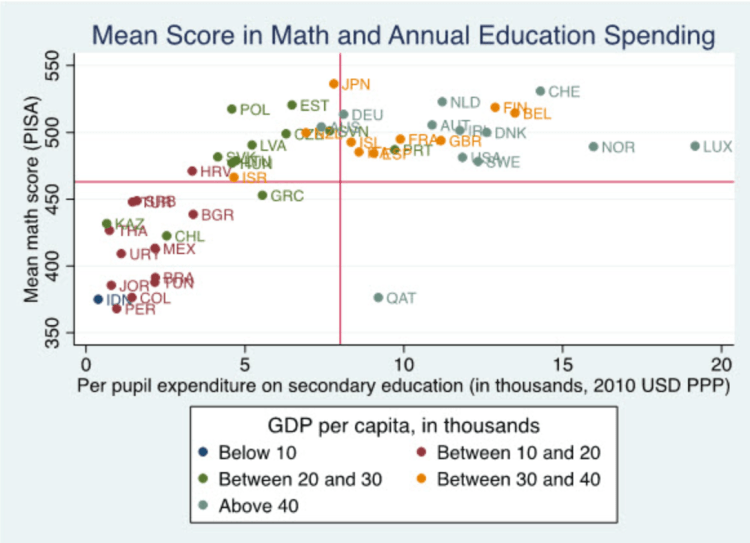
Our findings, reported in the Comparative Education Review suggest that, when education systems spend above $8,000, the association between student learning and per student spending is no longer statistically significant. Therefore, we find a threshold effect after this level of resources is met, indicating a declining relationship between resources and achievement at high levels of expenditure (consistent with other recent literature). This can be seen in Figure 2, where there is a positive relationship between student learning and per pupil expenditure among the low-spending countries (below $8,000 per student), but a flat relationship among high-spending countries.
Figure 2: Per student expenditures and mean math scores, separating low- from high-spending countries
Source: Vegas and Coffin, 2015.
Chosen excerpts by Job Market Monitor. Read the whole story at Why money matters for improving education | Brookings Institution



 Job Market Monitor
Discussion
No comments yet.