CIO Magazine Publisher Emeritus Gary J. Beach has been studying the skills gap problem for a number of years and has authored numerous articles on the subject. In 2013, he published a book titled The U.S. Technology Skills Gap. I recently asked him why there is an overall lack of awareness about the skills gap in the United States. He responded that “we have no tangible way to gauge it. A term with the word ‘gap’ prominently displayed, needs some sort of measurement.”
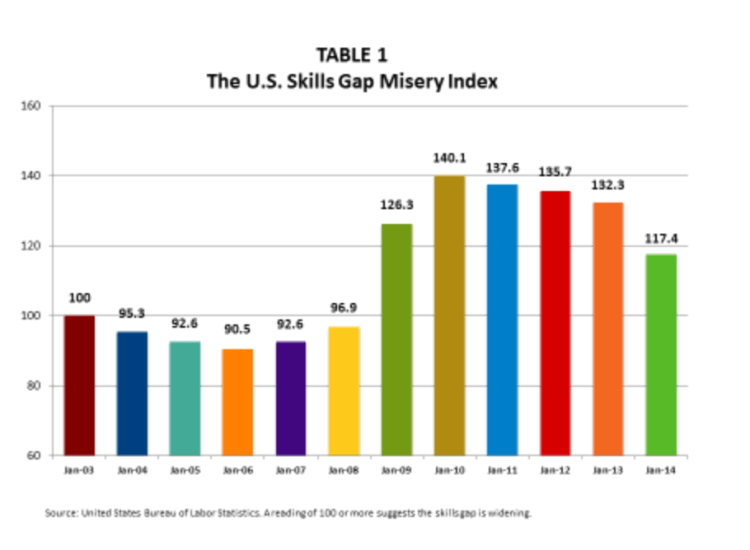
Challenged with this paradox, he set out to find a way to measure the gap and came up with an ingenious solution that he calls the Skills Gap Misery Index (SGMI).
To create his Index, Beach makes use of monthly data from the Bureau of Labor Statistics. He starts with the “job openings” number identified in the monthly Job Opening Labor Turnover (JOLT) report and adds the number of Americans included in the monthly U-6 Unemployment Rate.
The JOLT number reflects the millions of individual jobs available in the U.S. at the time of the report while the U-6 number shows the millions of Americans who are presently unemployed and underemployed, including those who have simply stopped looking for work.
When plotted, the combined JOLT and U-6 numbers reveal our nation’s ability (or inability) to place unemployed workers into unfilled positions over time. Beach indexed his findings back to January 2003 to provide a full 10-year look at the SGMI between January 2004 and January 2014 .
Chosen excerpts by Job Market Monitor. Read the whole story at The Skills Gap Misery Index | Dr. Bill R. Path.



 Job Market Monitor
Discussion
Trackbacks/Pingbacks
Pingback: Skills Gap in US – The next generation of workers won’t be able to fill the void | Job Market Monitor - March 5, 2016