Over the past 25 years, the total immigrant population has increased and spread across the country. In 1990, the foreign-born population was 19.7 million or 7.9 percent of the U.S. total, with nearly 3 out of 4 immigrants (73 percent) living in either California, Florida, Illinois, New Jersey, New York, or Texas.2 By 2010, approximately 40 million immigrants made up 13 percent of the overall population, and the proportion of immigrants residing in the six leading states dropped to 65 percent. Over that same time, other states including Nevada, North Carolina, and Washington experienced large growth in their foreign-born populations. 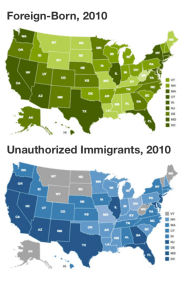
An examination of county-level demographic data reveals how immigrants affected population change in specific regions of the country between 1990 and 2012. While the native- and foreign-born populations both grew across most of the United States during that period, there are some areas where the native-born population decreased. This brief illustrates how, in some places, an influx of foreign-born individuals slowed overall population loss and even reversed it. This is consistent with past research that has found that immigration continues to shape the country’s demography, particularly in newer immigrant destinations. The Chicago Council on Global Affairs has shown that immigration has mitigated population loss in the Midwest at the state level and in metropolitan areas. Researchers reported in the journal Rural Sociology that immigrants reduced population loss in nonmetropolitan counties during the 1990s. This brief updates and expands on previous research by providing a county-level analysis of the entire nation over two decades and presenting the demographic context for future research on the impact of immigration on state and local economies and budgets.
Key trends
- Immigrants have moved beyond traditional gateways. Map 1 illustrates how growth in the foreign-born population has extended beyond traditional gateways—such as California, Florida, Illinois, New Jersey, New York, and Texas—into other areas of the United States, especially the Southeast and the Pacific Northwest.
- Native-born population has declined in Middle America. Map 2 shows that while the foreign-born population was increasing and dispersing, the native-born population was declining in certain areas of the country. This trend is most strongly observed in the middle of the United States.
- Immigration has driven population growth in the Sun Belt, Pacific Northwest, and Mountain States. Map 3 shows areas where the overall population has increased and how the foreign-born population has contributed to that growth. Increases in the number of immigrants have driven overall growth in many counties, particularly in the South and West.
- Immigration has slowed population declines in Middle America. Map 4 illustrates the changes in foreign- and native-born populations and highlights areas where the growth of the foreign-born population has slowed overall decline and sometimes has overcome native-born losses for a net population gain.
Chosen excerpts by Job Market Monitor. Read the whole story at Changing Patterns in U.S. Immigration and Population: Immigrants Slow Population Decline in Many Counties.



 Job Market Monitor
Discussion
No comments yet.