Working, in America, is in decline. The share of prime-age men — those 25 to 54 years old — who are  not working has more than tripled since the late 1960s, to 16 percent. More recently, since the turn of the century, the share of women without paying jobs has been rising, too. The United States, which had one of the highest employment rates among developed nations as recently as 2000, has fallen toward the bottom of the list.
As the economy slowly recovers from the Great Recession, many of those men and women are eager to find work and willing to make large sacrifices to do so. Many others, however, are choosing not to work, according to a New York Times/CBS News/Kaiser Family Foundation poll that provides a detailed look at the lives of the 30 million Americans 25 to 54 who are without jobs.
Many men, in particular, have decided that low-wage work will not improve their lives, in part because deep changes in American society have made it easier for them to live without working. These changes include the availability of federal disability benefits; the decline of marriage, which means fewer men provide for children; and the rise of the Internet, which has reduced the isolation of unemployment.
via The Vanishing Male Worker: How America Fell Behind – NYTimes.com.
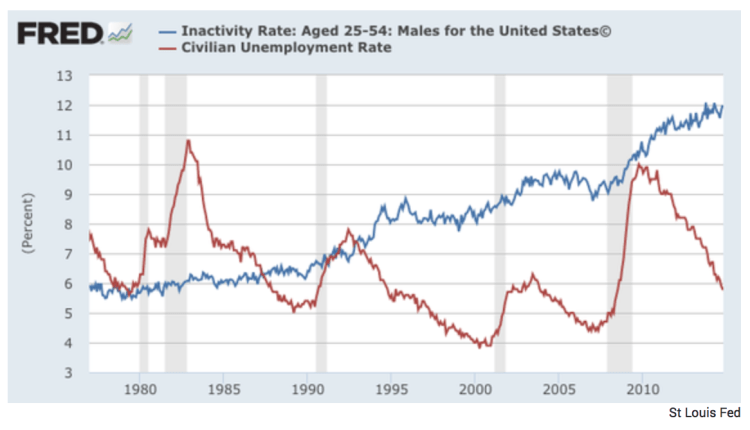 Source: The Mysterious Rise of the Non-Working Man – The Atlantic.



 Job Market Monitor
Discussion
Trackbacks/Pingbacks
Pingback: Men Who Don’t Work in US – A Chart | Job Market Monitor - December 17, 2014