Under the federal-state Unemployment Insurance (UI) system, there is currently no prohibition on the receipt of UI benefits by high-income unemployed workers. States, which determine many of the eligibility requirements for UI benefits, may not restrict eligibility based on individual or household income.
Recent Congresses, however, have considered proposals to restrict the payment of unemployment benefits to high-income individuals. These proposals define high income in a variety of ways— often prohibiting UI benefits for “millionaires.”
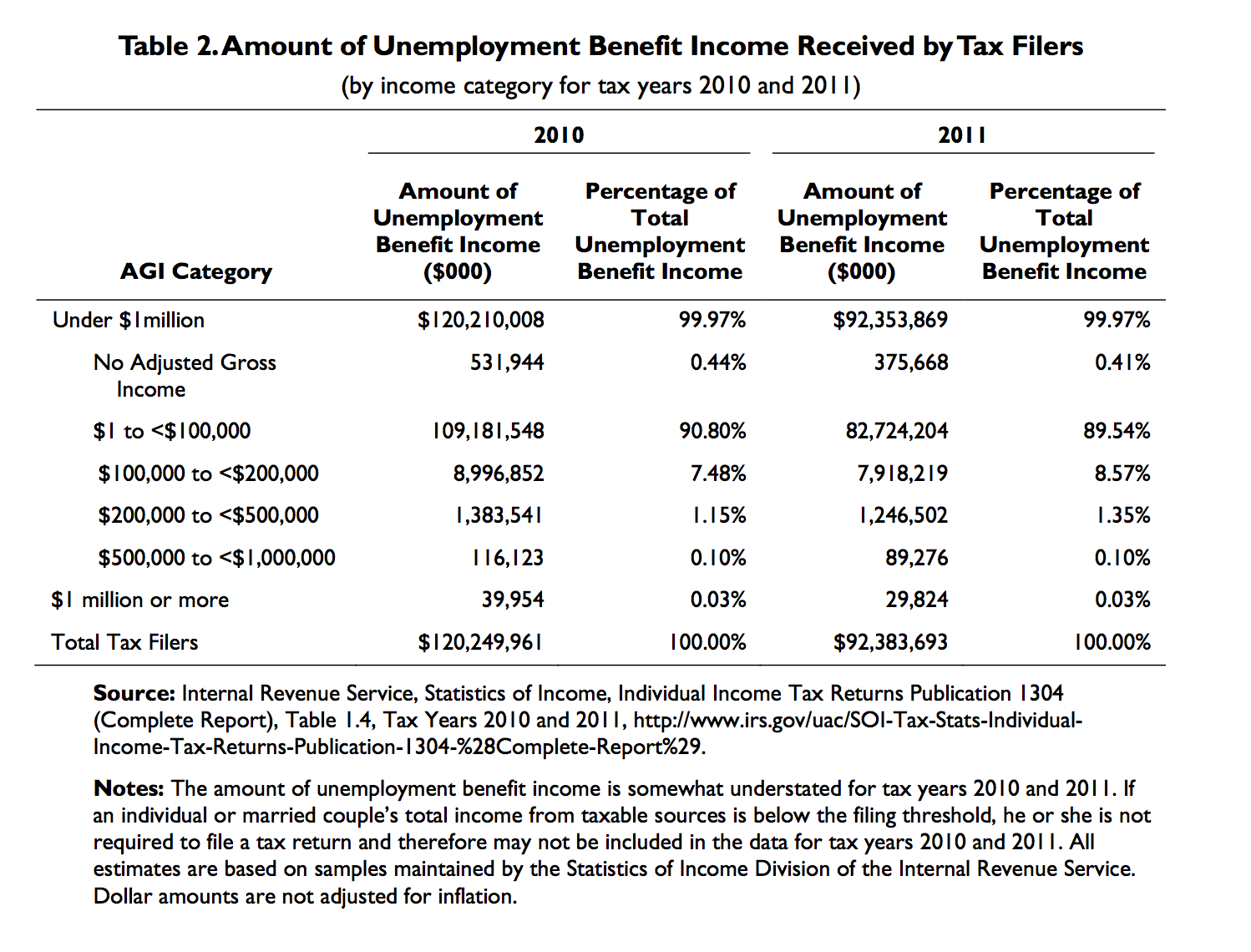
Table 2 shows the amount of unemployment benefit income received by tax filers by AGI category for tax years 2010 and 2011, where incomes are not adjusted for inflation. As shown in the table, the amount of unemployment benefit income received by tax filers with AGI of
$1 million or more is relatively small. For tax year 2010, tax filers with at least $1 million in AGI reported receiving $40.0 million in unemployment benefit income, which represents 0.03% of total reported unemployment benefit income. Similarly, for tax year 2011, tax filers with at least $1 million in AGI reported receiving $29.8 million in unemployment benefit income, which also represents 0.03% of total reported unemployment benefit income.
Chosen excerpts by Job Market Monitor. Read the whole story at Receipt of Unemployment Insurance by Higher-Income Unemployed Workers (“Millionaires”)
Related Post
US – Unemployment Insurance – 711 000 Households with Income of $100,000 or more had received benefits
The report Receipt of Unemployment Insurance by Higher-Income Unemployed Workers (“Millionaires”) by Donald Hirasuna from Congressional Research Service provides information relevant to proposals that would restrict the payment of unemployment benefits to individuals with high incomes. (Adapted excerpts by Job Market Monitor) Summary The economic recession that began in December 2007 officially ended in June 2009 when the U.S. economy reached a … Continue reading



 Job Market Monitor
Discussion
No comments yet.