The authors analyse high-tech employment and wage trends in the European Union (EU-27) between 2000 and 2011.1 Using a broad industry-occupation framework, we define high-tech workers as those employed in a high-tech industry or a STEM (science, technology, engineering, and math) occupation. This comprehensive analysis of the high-tech workforce highlights the important role high-tech workers play in job creation, income generation, and economic growth.
Among the major findings:
• In 2011, the 22 million high-tech workers employed in the EU-27 represented 10 percent of total employment. At 13.7 percent of total employment, Czech Republic had the highest concentration. Finland, Sweden, Denmark, France, and eight additional countries had high-tech employment shares above 10 percent of total employment.
• At 21.9 percent, Germany contributed the most to overall EU-27 high-tech employment. Germany, along with France, Italy, and the United Kingdom, collectively accounted for 60 percent of total high-tech employment in the EU-27 in 2011.
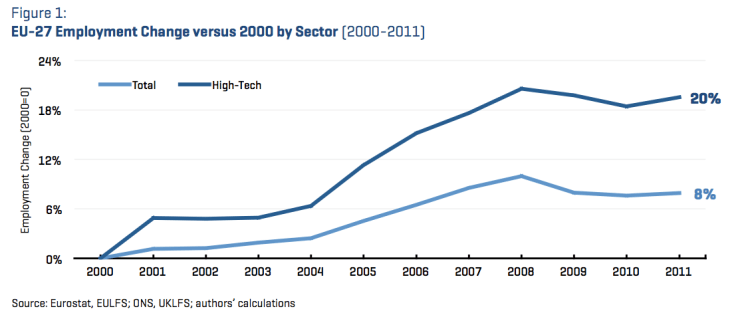
• High-tech employment grew 20 percent in the EU-27 between 2000-2011, as total employment increased by 8 percent. Each EU-27 country saw high-tech employment increase, and 22 of those had high-tech employment growth outpace total employment growth during the same period.2
• High-tech employment growth spread throughout Europe in the decade–on average, increasing the most in countries and regions with lower levels of high-tech employment concentration. This suggests that countries and regions that had been previously less established in high-tech are catching-up and playing an increasingly important role.
• High-tech workers experience more favourable labour market outcomes than workers as a whole, as evidenced by lower unemployment rates, the existence of a substantial wage premium, and stronger wage growth.3 These factors reflect both the relatively high demand for these workers and the economic value they create.
o The high-tech unemployment rate has consistently been below 4 percent and was lower than for total unemployment for each EU-27 country in 2010.
o High-tech workers earn much higher wages than workers in other sectors. Even after controlling for factors outside of industry or occupation that affect wages, high-tech workers earn 19 percent more than comparable workers.
o Wage growth has been stronger for high-tech workers than for total workers in 20 of the 26 countries where the data are available for this calculation.
• Beyond the direct impact that high-tech workers have on productivity in technology-adopting sectors throughout the economy, the high-tech sector itself is also an important contributor to income generation and economic development. We estimate that the creation of one high-tech job in a local economy creates more than four additional non-high tech jobs in the same region. This includes workers across the skill spectrum—such as lawyers, physicians, waiters, taxi drivers, schoolteachers, managers, and technologists.
Chosen excerpts by Job Market Monitor. Read the whole story at High-Technology Employment in the European Union




 Job Market Monitor
Discussion
Trackbacks/Pingbacks
Pingback: Tech Jobs in Canada / Big data and business intelligence pay best | Job Market Monitor - February 6, 2014
Pingback: EU labour market / A growing North-South divide | Job Market Monitor - February 24, 2014
Pingback: Jobs in US Tech-Sector – About 3.9 million workers, roughly 3% of the nation’s payroll workforce | Job Market Monitor - March 12, 2014