Eurostat estimates that 26.654 million men and women in the EU-28, of whom 19.298 million were in the euro area (EA-17), were unemployed in October 2013. Compared with September 2013, the number of persons unemployed decreased by 75 000 in the EU-28 and by 61 000 in the euro area. Compared with October 2012, unemployment rose by 512 000 in the EU-28 and by 615 000 in the euro area.
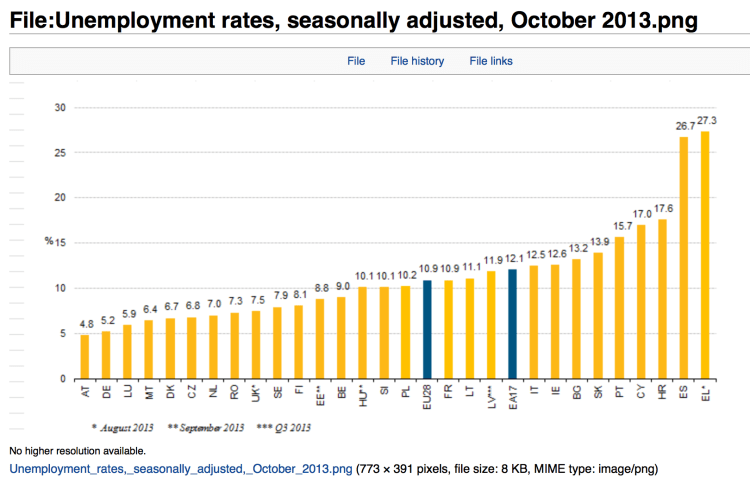
The euro area seasonally-adjusted unemployment rate was 12.1 % in October 2013, down from 12.2 % in September; it was 11.7 % in October 2012. The EU-28 unemployment rate was 10.9 % in October 2013, stable compared with September; it was 10.7 % in October 2012.
Among the Member States, the lowest unemployment rates were recorded in Austria (4.8 %), Germany (5.2 %) and Luxembourg (5.9 %), and the highest rates in Greece (27.3 % in August 2013) and Spain (26.7 %).
Compared with a year ago, the unemployment rate increased in half of the Member States and fell in half. The highest increases were registered in Cyprus (13.2 % to 17.0 %), Greece (25.5 % to 27.3 % between August 2012 and August 2013) and the Netherlands (5.5 % to 7.0 %. The largest decreases were observed in Latvia (14.0 % to 11.9 % between the third quarters of 2012 and 2013), Ireland (14.5 % to 12.6 %) and Lithuania (13.0 % to 11.1 %).
In October 2013, the unemployment rate in the United States was 7.3 %, up from 7.2 % in September 2013 and down from 7.9 % in October 2012.
In October 2013, 5.657 million young persons (under 25) were unemployed in the EU-28, of whom 3.577 million were in the euro area. Compared with October 2012, youth unemployment decreased by 29 000 in the EU-28, but increased by 15 000 in the euro area. In October 2013, the youth unemployment rate was 23.7 % in the EU-28 and 24.4 % in the euro area, compared with 23.3 % and 23.7 % respectively in October 2012. In October 2013 the lowest rates were observed in Germany (7.8 %), Austria (9.4 %) and the Netherlands (11.6 %), and the highest in Greece (58.0 % in August 2013), Spain (57.4 %) and Croatia (52.4 % in the third quarter 2013).
Youth unemployment trends
Youth unemployment rates are generally much higher than unemployment rates for all ages. Until the end of 2008, the youth unemployment rate in the EU-27 has been around twice as high as the rate for the total population, reaching its minimum value (18.1 %) in the first quarter 2008. The economic crisis, however, seems to have hit the young more than other age groups. From the beginning of 2009, the gap between the youth and the total unemployment rates has increased, so that at the end of 2012 the youth unemployment rate was 2.6 times the total rate. The EU-27 youth unemployment rate was systematically higher than in the euro area between 2000 and mid-2007. Since then and until the third quarter 2010 these two rates have been very close. Afterwards the indicator has moved more sharply in the EA-17 than in the EU-27, first downwards, until mid-2011, then upwards until the end of 2012 (see also Figure 5). In the middle of 2012 the euro area youth unemployment rate has overtaken the EU-27 rate, and the gap has increased until the end of the year.
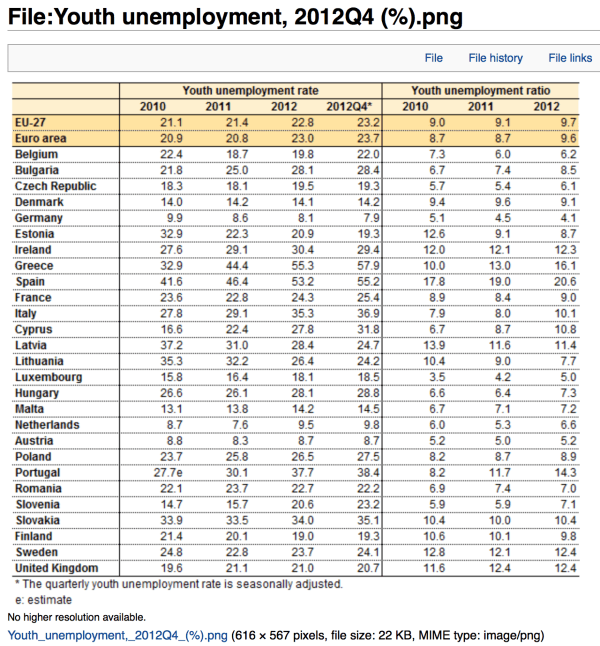
High youth unemployment rates do reflect the difficulties faced by young people in finding jobs. However, this does not necessarily mean that the group of unemployed persons aged between 15 and 24 is large, as many young people are studying full-time and are therefore neither working nor looking for a job (so they are not part of the labour force which is used as the denominator for calculating the unemployment rate). For this reason, youth unemployment ratios are calculated as well, according to a somewhat different concept: the unemployment ratio calculates the share of unemployed for the whole population. Table 1 shows that youth unemployment ratios in the EU are much lower than youth unemployment rates; they have however also risen since 2008 due to the effects of the crisis on the labour market.
Chosen excerpts by Job Market Monitor. Read the whole story at




 Job Market Monitor
Discussion
No comments yet.