The U.S. is not a meritocracy. As Kimberly Howard and I point out in our new paper “The Glass Floor,” there are plenty of smart, low-income kids who remain stuck at the bottom of the income distribution as adults—and plenty of less-smart, better-off kids who remain on a high rung of the ladder.
Skills Matter
This is not to say that skills don’t matter. In fact, skills matter a lot. We compare the mobility patterns for adolescents in the top and bottom third of scores for smarts (using a cognitive test) and those scoring high or low on a widely-used measure of “drive” or persistence (using a coding speed test).
“Smarts” Matter
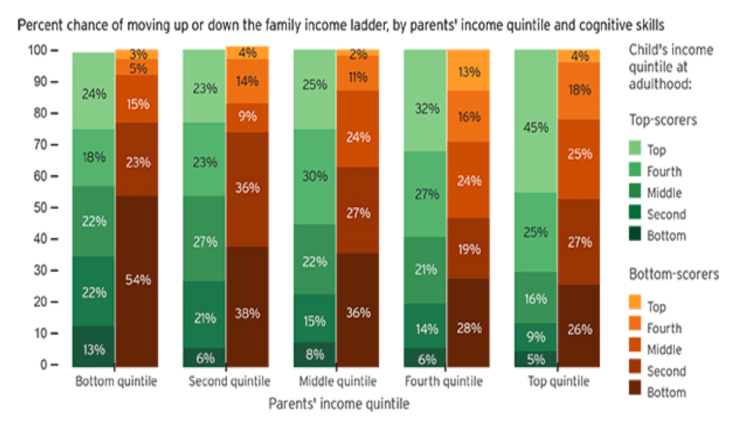
The difference in the mobility patterns for the high-skill and low-skill adolescents, compared to overall patterns is striking. High-“smarts” adolescents in the bottom income quintile have a 24% chance of making it to the top quintile, which is similar to the rates seen among high-skill students in the middle income quintiles:
Chosen excerpts by Job Market Monitor. Read the whole story at

via Skills Matter for U.S. Social Mobility | Brookings Institution.



 Job Market Monitor
Discussion
Trackbacks/Pingbacks
Pingback: Intergenerational mobility in the US / A Map | Job Market Monitor - February 6, 2014