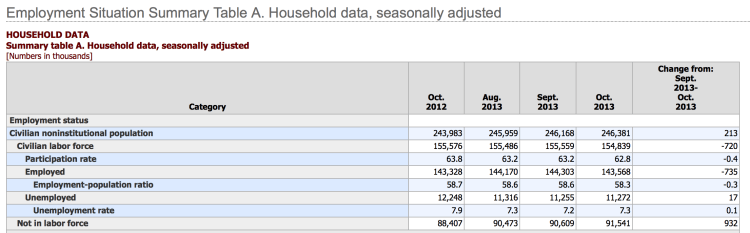
Editor’s Note: Job creation picks up despite government shutdown. Indeed, furloughed workers are counted on the payroll. But the household survey says something else: a drop of -735,000 in the number of people employed. Furloughed are counted as unemployed in the household survey. At best, the household survey says that total job creation, outside the government shutdown, would have been insignificant. Hence, the employment population ratio is at 58.3%, down by 0,4 pp since a year and 0,3 pp since a month. Hardly good news.
The WSJ writes that this “might allow Federal Reserve policy makers to consider reducing the pace of the $85 billion-a-month bond-buying program at its next meeting, set for December”. But the unemployment rate will not go down in a sustain manner while the population ratio drops. It is the Household Survey which drives the unemployment rate, not the payroll count.
__________
The report
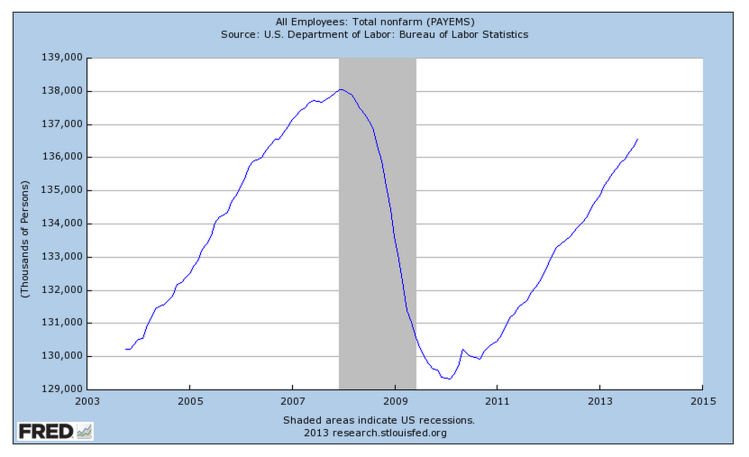
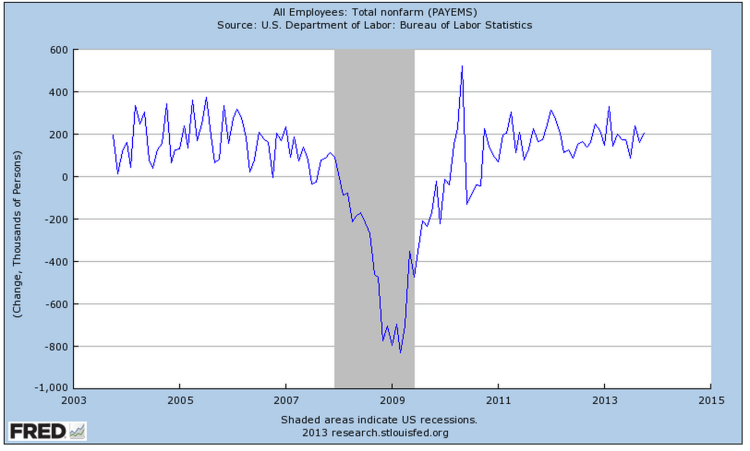
Total nonfarm payroll employment rose by 204,000 in October, and the unemployment rate was little changed at 7.3 percent, the U.S. Bureau of Labor Statistics reported today. Employment increased in leisure and hospitality, retail trade, professional and technical services, manufacturing, and health care.
Household Survey Data
Both the number of unemployed persons, at 11.3 million, and the unemployment rate, at 7.3 percent, changed little in October. Among the unemployed, however, the number who reported being on temporary layoff increased by 448,000. This figure includes furloughed federal employees who were classified as unemployed on temporary layoff under the definitions used in the household survey. (Estimates of the unemployed by reason, such as temporary layoff and job leavers, do not sum to the official seasonally adjusted measure of total unemployed because they are independently seasonally adjusted.) For more
information on the classification of workers affected by the federal government shutdown, see the box note. (See tables A-1.)
Among the major worker groups, the unemployment rates for adult men (7.0 percent), adult women (6.4 percent), teenagers (22.2 percent), whites (6.3 percent), blacks (13.1 percent), and Hispanics (9.1 percent) showed little or no change in October. The jobless rate for Asians was 5.2 percent (not seasonally adjusted), little changed from a year earlier.
The number of long-term unemployed (those jobless for 27 weeks or more) was little changed at 4.1 million in October. These individuals accounted for 36.1 percent of the unemployed. The number of long-term unemployed has declined by 954,000 over the year.
The civilian labor force was down by 720,000 in October. The labor force participation rate fell by 0.4 percentage point to 62.8 percent over the month. Total employment as measured by the household survey fell by 735,000 over the month and the employment-population ratio declined by 0.3 percentage point to 58.3 percent. This employment decline partly reflected a decline in federal government employment.
The number of persons employed part time for economic reasons (sometimes referred to as involuntary part-time workers) was little changed at 8.1 million in October. These individuals were working part time because their hours had been cut back or because they were unable to find a full-time job.
Chosen excerpts by Job Market Monitor. Read the whole story at

via Employment Situation Summary.
The WSJ’s analysis
In October Jobs Report, U.S. Hiring Picks Up Strongly
Job creation accelerated in October and the prior two months of data were revised up, raising the prospect that the labor market may be strengthening enough for the Federal Reserve to start pulling back its easy-money policies soon.
U.S. payrolls advanced by 204,000 jobs last month, the Labor Department said Friday. That handily topped economists’ forecast for an increase of 120,000.
The prior two months were revised up by a total of 60,000. The September gain was revised to 163,000 from an initial estimate of 148,000, and the August payroll improvement was revised to 238,000 from 193,000.
The Labor Department said the private sector added 212,000 jobs in October, the strongest gain since February, suggesting companies shrugged off the government shutdown last month.
Average job creation over the past three months now exceeds a 200,000 pace, matching the strong gains recorded in early in the year.
U.S. payrolls advanced by 204,000 jobs last month, and the unemployment rate reached 7.3 percent. WSJ’s Sudeep Reddy and Phil Izzo break down the jobs data and discuss how they could impact Fed policy. Photo: Getty Images.
The improvement might allow Federal Reserve policy makers to consider reducing the pace of the $85 billion-a-month bond-buying program at its next meeting, set for December. The Fed has tied a reduction in bond purchases, which are aimed at driving down interest rates and encouraging spending and hiring, to improvement in the labor market.
The nation’s unemployment rate, obtained through a separate survey of households, rose slightly to 7.3% from 7.2% in September. The small increase—the first in three months—reflects federal employees who were furloughed last month in a 16-day government shutdown. Those workers have been classified as unemployed during the week reflected in the survey, even though they later returned to their jobs and received back pay.
Chosen excerpts by Job Market Monitor. Read the whole story at

via In October Jobs Report, U.S. Hiring Picks Up Strongly – WSJ.com.
In Charts





 Job Market Monitor
Discussion
No comments yet.