This paper reviews the history of Canadian immigration policies and documents that the present policies impose on Canadians a fiscal burden of $20 billion annually. The existence of this burden is attributed to flaws in the current immigrant selection process, some of which are addressed through recent changes in policies adopted by the government. These changes are discussed and viewed likely to reduce the fiscal burden by only small amounts. The paper proposes more radical reforms to the selection system to eliminate the fiscal burden in the future.
Highlights
Recent immigrants impose a fiscal burden on Canadian taxpayers of about $20 billion annually due to the fact that they earn less and pay less taxes than the benefits they receive from government spending. The economic benefits from the complementarity of immigrant and native labour raising the wages of both and economies of scale due to immigration, the reduction in the unfunded liabilities of social programs, the foreign investment in immigrant human capital, and others are non-existent, or very small, in relation to the size of the fiscal burden.
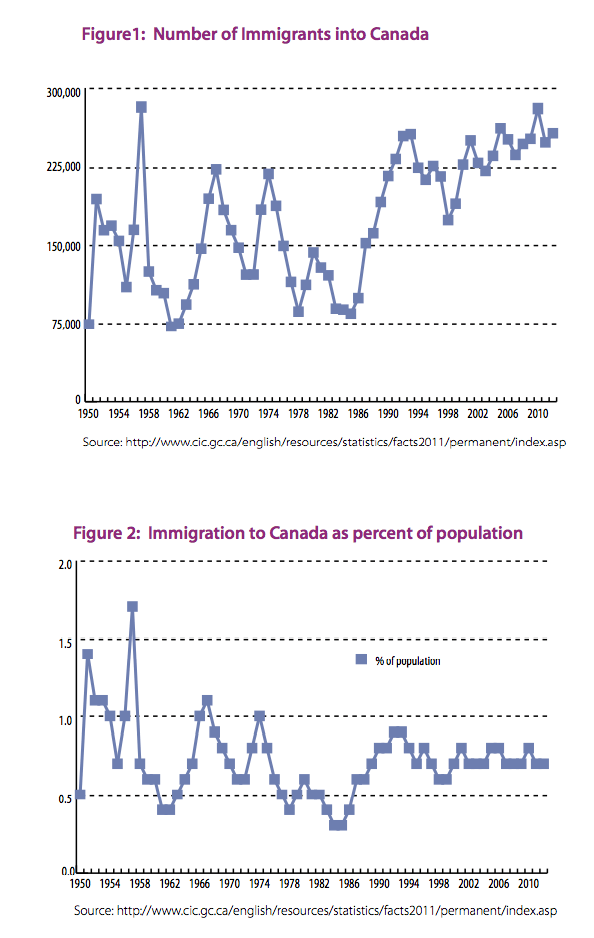
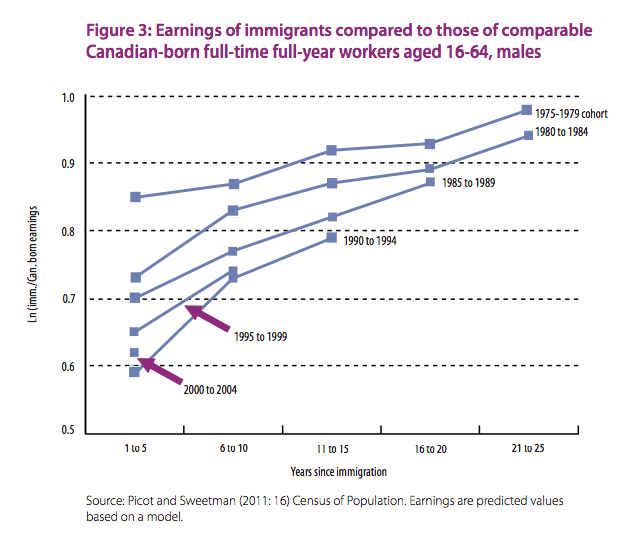
Low earnings are unexpected since Canada selects immigrants on the basis of their prospects for economic success, using an objective points sys- tem that reflects the candidates’ educational attainment, work experience, language competence, and other indicators that are correlated with higher earnings. Individuals selected on this basis are considered to be “economic immigrants” who, in 2011, according to government statistics, represented 62.8 percent of all immigrants when their immediate family members are included.
In recent years, under Minister of Immigration Jason Kenney, the gov- ernment introduced many changes to immigration policies, which aim in part, at lowering the fiscal burden through the use of more efficient selection processes, better information about candidate qualifications, speeding up the processing of refugee claims, reducing opportunities for fraud, increas- ing the financial responsibility of sponsors of parents and grandparents, and various other measures.
These policy changes are likely to reduce the size of the fiscal burden. Most promising are the reforms to the refugee system and of the financial requirements for the sponsorship of parents and grandparents. The ultimate effects will depend greatly on the enforcement of the new rules in practice
and on how parents and grandparents are treated if their sponsors renege on their promise of financial support.
The changes of the process used to select economic immigrants such as modifications of the points system, the verification of certificates of edu- cational achievement, and language competence are likely to be positive but small and depend on the actual level of enforcement.
This paper proposes that immigration of parents and grandparents be stopped completely but the changes should be phased in by making it applic- able only to new immigrants arriving after the adoption of the proposed policy, allowing immigrants already in Canada to continue with the sponsorship of their parents and grandparents.
The paper also proposes that the current immigrant selection process, which relies heavily on political considerations, be replaced with one that relies primarily on the private sector and labour market conditions. Under this proposed system the government would remain deeply involved by set- ting the minimum pay required to make job offers acceptable for the issu- ance of immigrant visas. It would also play an important role in protecting the public interest through health and security checks.
Concluding this paper is an argument advocating that Minister Kenney spearhead a public inquiry and wide discussion of the optimal number of immigrants that are admitted into Canada on economic and humanitarian grounds and after evaluation of views expressed by the general public through informal surveys, the response to which is completely voluntary. Presently, this number is decided by the minister and routinely receives parliamentary approval without explanation of its economic rationale and social-cultural consequences.
Chosen excerpts by Job Market Monitor. Read the whole story at




 Job Market Monitor
Discussion
Trackbacks/Pingbacks
Pingback: Canada / Increases in immigration level bring immigrants real wages down | Job Market Monitor - February 13, 2014
Pingback: Immigrants in Canada – Things changed for arrivals in the 2000s: the entry earnings advantage decreased continuously Stat Can finds | Job Market Monitor - May 29, 2014
Pingback: Recent Immigrants in Canada – 14 per cent of university-educated are unemployed, 3.3 per cent for Canadian-born university grads | Job Market Monitor - August 1, 2014