In an essay from the Federal Reserve Bank of St. Louis’ new Center for Household Financial Stability, the authors provide data on the damage to household wealth during the Great Recession, explore the circumstances that led to large declines in household wealth, make the case that such wealth has not fully recovered and show why all of that matters for U.S. economic recovery.
The essay was authored by the Center’s director, Ray Boshara, and chief economist, William Emmons, and it was published May 30, 2013, as part of the St. Louis Fed’s annual report. The analysis highlights the focus of the new Center—rebuilding the household balance sheets of struggling American families.
Boshara and Emmons featured several findings: 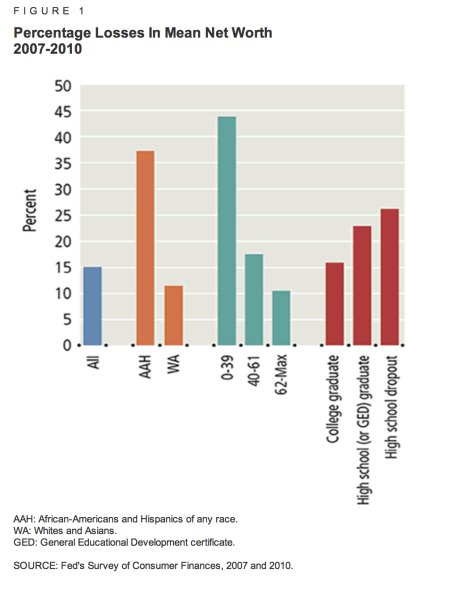
- Average household wealth in real terms, contrary to recent headlines, has not fully recovered; indeed, it is only about halfway back to prerecession levels.
- While many Americans lost wealth because of the recession, younger, less-educated and/or African-American and Hispanic families lost the most, in percentage terms.
- Those subgroups had higher-than-average concentrations of their wealth in housing and higher debt-to-asset ratios than less economically vulnerable groups.
- The very families most exposed to the economic fallout of a deep recession—fallout that came in the form of job loss or reduced income—possessed the weakest and riskiest balance sheets.
- Balance sheet failures were important contributors to the downturn and weak recovery.
Chosen excerpts by Job Market Monitor
via St. Louis Fed Releases Key Findings of New Research Center on Household Financial Stability.



 Job Market Monitor
Discussion
Trackbacks/Pingbacks
Pingback: US – Employment recovery has been historically slow writes Atlanta Fed in its Annual Report | Job Market Monitor - March 21, 2014