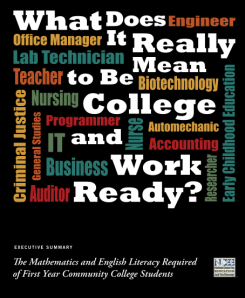
NCEE has released What Does It Really Mean to Be College and Work Ready?, a study of the English Literacy and Mathematics required for success in the first year of community college. During a day-long meeting with key education and policy leaders, NCEE will discuss the results of the study and its implications for community college reform, school reform, teacher education, the common core state standards, and vocational education and the workplace.
The findings for Mathematics
A substantial part of the high school mathematics we teach is mathematics that most students do not need, some of what is needed in the first year of community college is not taught in our schools, and the mathematics that is most needed by our community college students is actually elementary and middle school mathematics that is not learned well enough by many to enable them to succeed in community college. A significant body of research on teacher knowledge, including the work of Liping Ma, Jim Stigler and Deborah Ball, makes it clear that one reason for this is because the instruction in arithmetic, ratio, proportion, expressions and simple equations that our teachers have received in school and in college falls far short of what it needs to be for them to have a sound conceptual grasp of the mathematics they are asked to teachMany community college career programs demand little or no use of mathematics. To the extent that they do use mathematics, the mathematics needed by first year students in these courses is almost exclusively middle school mathematics. But the failure rates in our community colleges suggest that many of them do not know that math very well. A very high priority should be given to the improvement of the teaching of proportional relationships including percent, graphical representations, functions, and expressions and equations in our schools, including their application to concrete practical problems.
Whatever students did to pass mathematics courses in middle school, it does not appear to require learning the concepts in any durable way. While they may have been taught the appropriate procedures for solving certain standard problems, the high rates of non-completion by the significant percentages of students who arrive at college with the most modest command of mathematics suggests that there are significant weaknesses in teaching the concepts on which these procedures are based. This is a very serious problem that needs to be addressed in the first instance by the way mathematics is taught to prospective teachers of elementary and middle school mathematics in the arts and sciences departments of our universities and the way mathematics education is taught in our schools of education.
Chosen excerpts by Job Market Monitor from



 Job Market Monitor
Discussion
No comments yet.