Up until about 15 years ago, you could have nicely employed this picture against your Luddite friends who complain about productivity killing jobs.
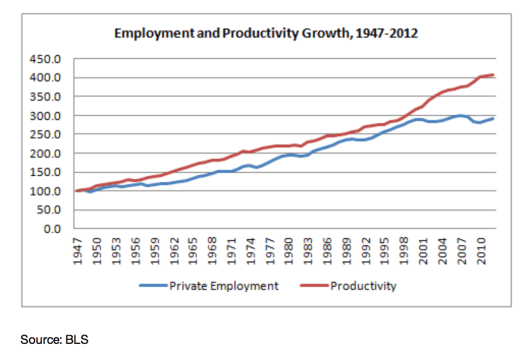
Until then, the two lines largely grew together. Yes, we were more productive, but growth resulted in higher demand that fed back into the economy’s job-creation function in ways that boosted job growth. The income and wage benefits of growing productivity certainly haven’t reached very far down the income scale since the late 1970s—that’s the inequality story. But even as inequality grew in the 1980s and 1990s, job creation largely kept pace with output per hour.
That hasn’t been the case since, and it is a matter of grave concern. The reasons go beyond my scope here, but a prime suspect observed at the crime scene is an acceleration of labor-saving capital investment, like robotics (see Brynjolfsson and McAfee for incisive work on this question).
Chosen excerpts by Job Market Monitor

via Getting Back to Full Employment | Jared Bernstein | On the Economy.



 Job Market Monitor
Discussion
Trackbacks/Pingbacks
Pingback: US Jobs Gap in March 2014 – 7.4 million jobs says the Hamilton Project | Job Market Monitor - April 7, 2014