Second-generation Americans—the 20 million adult U.S.-born children of immigrants—are substantially 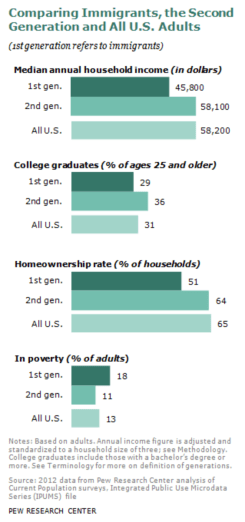 better off than immigrants themselves on key measures of socioeconomic attainment, according to a new Pew Research Center analysis of U.S. Census Bureau data. They have higher incomes; more are college graduates and homeowners; and fewer live in poverty. In all of these measures, their characteristics resemble those of the full U.S. adult population.
Hispanics and Asian Americans make up about seven-in-ten of today’s adult immigrants and about half of today’s adult second generation. Pew Research surveys find that the second generations of both groups are much more likely than the immigrants to speak English; to have friends and spouses outside their ethnic or racial group, to say their group gets along well with others, and to think of themselves as a “typical American.”
The Pew Research surveys also find that second-generation Hispanics and Asian Americans place more importance than does the general public on hard work and career success. They are more inclined to call themselves liberal and less likely to identify as Republicans. And for the most part they are more likely to say their standard of living is higher than that of their parents at the same stage of life. In all of these measures, the second generation resembles the immigrant generation more closely than the general public.
Chosen excerpts by Job Market Monitor from

via Second-Generation Americans | Pew Social & Demographic Trends.
Related Posts
US / The 40 Million Immigrants, Including the 11 Million Unauthorized
The nation’s total immigrant population reached a record 40.4 million in 2011, according to an analysis of Census Bureau data by the Pew Hispanic Center, a project of the Pew Research Center. Over the last decade, the number of immigrants in the U.S. has steadily grown. Since 2007 alone, the number of immigrants living in … Continue reading »
US / 23% of undergraduates with at least one parent who is an immigrant
While people earning STEM degrees has been on the uptick in the past two decades, a more recent Census report shows that most of the degrees in computer, math, statistics, and engineering disciplines are still going to foreign-born residents, primarily to those from China and India. Below are some interesting facts (many referring to the … Continue reading »
US / 40 percent of Fortune 500 companies were founded by immigrants
Immigrant entrepreneurs are doing great things in America today. Lebanese born Dr. Charles Elachi is the Director of NASA’s Jet Propulsion Laboratory and his team just sent a rover to Mars. Russian born Sergey Brin is the co-founder of Google. In fact, a 2011 study found that 40 percent of Fortune 500 companies were founded … Continue reading »
US / Immigrants and Jobs ?
There are a lot of competing studies (and pundits) out there, but the general takeaway from conservative and liberal economists is that immigration is good for Americans’ living standards over the long run. That’s because immigrants raise the wages of native-born workers (and also lower the cost of immigrant-dense services like child care and cleaning). … Continue reading »
US Mexican immigrants / 64 percent have not pursued naturalization
Mexican immigrants living in the United States legally are slow to seek U.S. citizenship, results of a Pew study released Monday indicate. Of the 5.4 million legal Mexican immigrants, 64 percent have not pursued naturalization. The 36 percent who have is about half the rate of legal immigrants from all other countries combined, the Pew … Continue reading »
US / Birth Rate Falls to a Record Low, Worse Among Immigrants
The U.S. birth rate dipped in 2011 to the lowest ever recorded, led by a plunge in births to immigrant women since the onset of the Great Recession. The overall U.S. birth rate, which is the annual number of births per 1,000 women in the prime childbearing ages of 15 to 44, declined 8% from …Continue reading »
Brain Drain – US Driving Immigrant Talent Overseas
Asaf Darash, an Israeli entrepreneur, was putting his 18-month-old son to bed when he received the news he had been dreading. He had applied to renew his temporary visa back in April. It was now the middle of September, a few weeks away from his visa expiration, and immigration officials had still not responded. As … Continue reading »



 Job Market Monitor
Discussion
Trackbacks/Pingbacks
Pingback: US / Means-tested programs and tax credits for low-income households rose more than tenfold in the four decades since 1972 « Job Market Monitor - February 11, 2013
Pingback: US / Hispanics / Unemployment Rate Tops 17% in 5 States | Job Market Monitor - February 28, 2013
Pingback: US / Younger Generations Lag Parents in Building Wealth | Job Market Monitor - March 16, 2013
Pingback: New Immigrants in France – Fare badly in the first few years, but improvement over time finds research | Job Market Monitor - May 9, 2014